



When Kristin Berbawy arrived in Prague, she wasn’t expecting to find herself immediately at home. But a Maker Faire anywhere, feels a lot like home to a maker. Outside her hotel window, a giant laser sliced across the night sky from Prague’s iconic TV Tower as the city celebrated Liberation Day. It looked less like a historical commemoration and more like something you’d stumble across at Burning Man. A perfect preview for the mix of centuries of craft acumen combined with future-focused ingenuity that was ahead.


An obsessive maker and maker educator, Kristin has brought students to Maker Faire Bay Area for over a decade (learn more about her work). She has taught innumerable kids how to make robots, the wizardry of 3D printing, and the joy of experimenting and creating in community. This May, she took that opportunity for herself and traveled to Prague to check out what makers across the Atlantic get up to. Maker Faire Prague didn’t disappoint: Bigger than she expected and buzzing with thousands of visitors, packed exhibition halls, and the kind of joyful energy familiar to anyone who has wandered through a Maker Faire anywhere in the world. Familiar, she noted, but uniquely Czech — the universal language of making needed no translation. She drew an analogy to a previous experience visiting Disneyland in Hong Kong: everything was recognizable, but filtered through a different language, history, and cultural lens.

On the edge of one of Prague’s many large parks, Maker Faire Prague is the anchor of the dozen or so Maker Faires organized by the powerhouse Make More and with support form Prusa Lab that take place across the Czech Republic each year. For her time in Prague Kristin spent the weekend exploring drone racing arenas, laser harps, musical Tesla coils, and giant 3D-printed alpacas. She met teenage engineers building custom tool-changing 3D printers, artists turning glass rods into intricate beads, and makers transforming obsolete cassette tapes and floppy disks into something entirely new. She soldered electronics alongside strangers, shared project stories (successes and failures), and found herself repeatedly drawn to the same spirit of curiosity and generosity that powers maker communities she is more than familiar with in the Bay Area.
Aside from the participatory culture, learning by doing ethos, and community building through making that is at the heart of Maker Faire in both concept and execution, Kristin noted two things really stood out. First, was the freedom given to children. Young participants soldered, welded, built robots, and used tools with relatively little oversight. The atmosphere reflected a cultural confidence in children’s ability to learn through experience rather than being shielded from risk.


Second, the influence of Prusa was everywhere. Beyond sponsoring the event, the company embodied a broader appreciation for local manufacturing, technical skills, and iterative design. Conversations repeatedly returned to the value of making things locally and preserving hands-on expertise. Her tour of Prusa Lab and it printer farm and facilities exemplified the value, integration and community potential of the kind of mid-sized manufacturing that is still prevalent throughout Europe.

Projects, Projects, Projects
With over 200 projects on display from every corner of the makerverse, there was a lot to do over two days. We highlight a few here and share Kristin’s videos to do the rest of the talking.
WoopWhoop! One building housed a dedicated drone racing course featuring “tiny whoop” drones navigating hoops and obstacles at high speed. The competition showcased the growing popularity of organized drone sports and demonstrated their unique blend engineering with play.
So many robots! The trending prevalence of robotics clubs at Maker Faires across the world was on display in Prague — student teams filled the event with autonomous machines and engineering demonstrations. A robotics club leader herself, Kristin noted that while the projects resembled those found at U.S. Maker Faires, she was struck by how globally connected robotics education has become.
Mini Earth Worlds! One of the most popular hands-on activities allowed visitors to construct miniature ecosystems inside glass containers. Participants layered substrate, moss, rocks, and plants while learning about the biology behind self-contained terrariums, then took their creations home.


Space Books! An astrophysicist presented a series of beautifully illustrated children’s books that combined astronomy, mythology, and science education. Featuring stories inspired by Greek mythology, auroras, and space exploration, his goal was demonstrating how scientific concepts can be communicated through art and storytelling.

Laser Harp! Tesla Coils! If you’ve never seen a laser harp, seek one out. They’re magical. A darkened exhibit space featured a laser harp, allowing visitors to create music by interrupting beams of light. Kristin watched children experiment with the instrument before trying it herself. The same immersive electronics space featured musical Tesla coils and glowing plasma displays.

3D-Printed Mini Electric Motorcycle: One maker showcased a fully rideable miniature electric motorcycle constructed largely from printed PLA parts. Powered by tool batteries and equipped with working lights and storage compartments, the vehicle demonstrated how far hobbyist fabrication has advanced.


Urban gardening solutions designed for apartment living and compact indoor growing systems and enclosed plant ecosystems reflected the needs of city residents looking to incorporate nature into small living spaces.
Endless Slinky Machine: One of the event’s most whimsical projects transformed the classic stair-walking slinky into a continuous motion sculpture. A 3D-printed conveyor system allowed the slinky to climb endlessly, creating a mesmerizing kinetic display that delighted visitors of all ages.
Post-Apocalyptic Art Car Collective: A Czech maker group Raketová základna Bratronice brought a Mad Max-inspired art car complete with flame effects and costumed performers. Despite their intimidating appearance, the builders were welcoming and enthusiastic, reflecting the playful spirit common throughout the event.

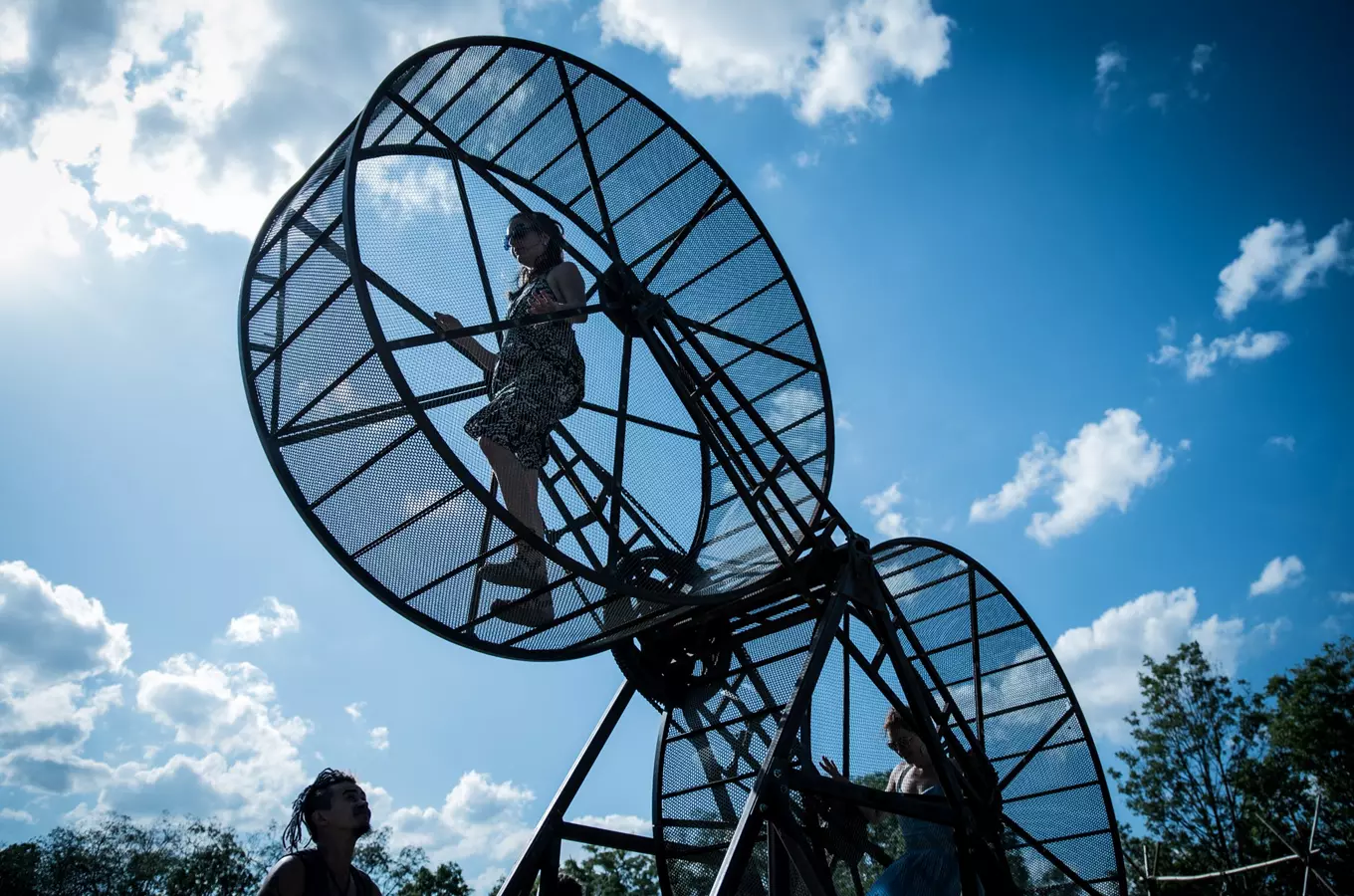
Human-Powered Multi-Rider Bicycle: An enormous collaborative bicycle allowed multiple riders to pedal together. The unusual vehicle highlighted the event’s recurring themes of community participation, engineering creativity, and playful experimentation.
Glass Bead Making Workshop: Among the many workshops on offer, Kristin highlighted the opportunity to work with molten glass. Visitors learned traditional lampworking techniques by melting colored glass rods in a flame and winding the molten glass around metal mandrels. She created her own bead while learning directly from the artist.
3D Printing From Prusa and Mod-madness!
Unsurprisingly, 3D printing and 3D printing mods were everywhere at MF Prague. Kristin called out two projects that really made an impression.

Eight-Toolhead Prusa Tool Changer: A major attraction at the Prusa booth was a new collaboration with Bondtech featuring an eight-toolhead system. The machine can automatically switch between multiple materials and print heads, dramatically expanding what can be produced in a single print job.
DIY Magnetic Tool-Changing Printer: A teenage maker presented a custom-built 3D printer featuring a self-designed magnetic tool-changing system. Built largely from printed parts, the project demonstrated both impressive technical skill and the growing sophistication of youth makers.

Hard-Drive Parts Printer: The same young inventor also displayed a smaller printer assembled from recycled components, including hard-drive parts. The machine embodied the maker ethic of experimentation, reuse, and learning through building. Youth-Built Frankenstein Orbital Tool Changer: Another standout student project came from a 17-year-old inventor who developed a rotating multi-tool print head system. Instead of swapping tools with magnets, the machine rotated among four print heads, offering an original solution to multi-material printing.
The Takeaway…
What stood out most wasn’t any single machine or invention — although there were plenty of innovations. It was the culture surrounding them. Kids were trusted with tools — even welders. Visitors were encouraged to participate rather than observe and, consequently nearly every exhibit invited people to touch, build, experiment, or learn. Her takeaway — Maker Faire Prague felt less like a technology expo and more like a giant playground. From advanced manufacturing and open-source hardware to handcrafted art and whimsical kinetic sculptures, it offered a reminder that making is more than a hobby. It’s a way of connecting people across languages, generations, and borders—a spirit thriving at every turn she took though the event and makers she connected with in the event.
A simple soldering booth became one of Kristin’s most memorable experiences. After helping a woman complete her first electronics project, the two became friends, spent the day exploring Maker Faire together, and later met up around Prague. The encounter illustrated how making can create meaningful human connections even between strangers from different countries.


After the event, a quick trip to the site of another smaller Czech Maker Faire event space, cemented these impressions as she joined a planning round table that was brainstorming content and engagement at the local level. Whether through advanced 3D printing, traditional crafts, artistic installations, or spontaneous friendships, the event demonstrated that maker culture thrives when people are empowered to build, experiment, and learn together. Many of her most memorable moments came from conversations rather than learning the nuts and bolts of technology projects. Whether helping a stranger learn to solder or talking with young inventors about their projects, the event demonstrated how making serves as a universal language.
And lastly, what would a trip to Maker Faire Prague and Prusa Lab be without some dedicated alpaca time. Including, a life-sized 3D-printed alpaca within the event at the Prusa exhibit inspired by the animals that live at the company’s headquarters.

