


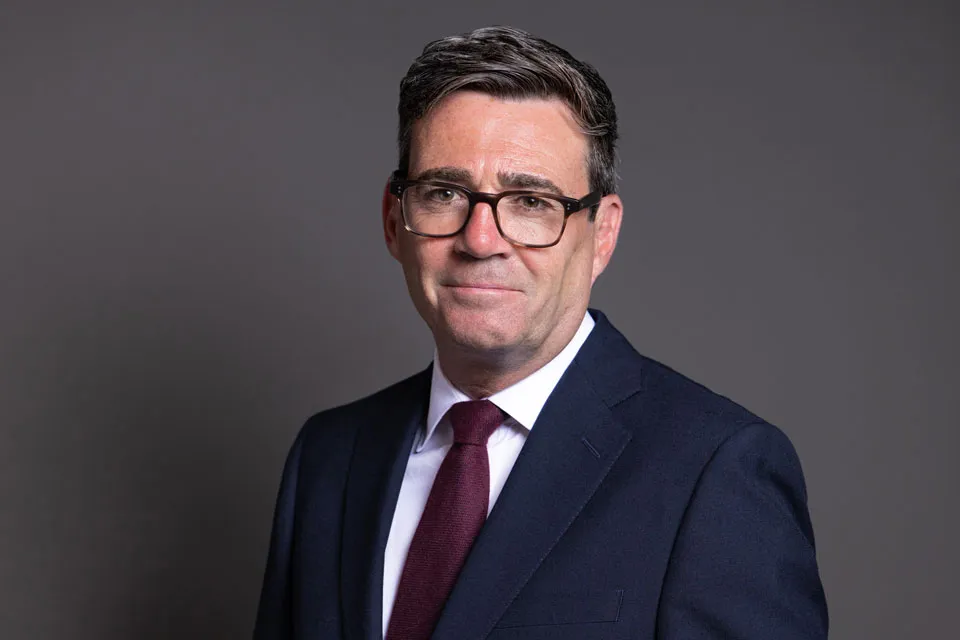
Andy Burnham has pledged to do more to ‘lift up’ the social care workforce, providing reforms on pay, training and bringing it into closer alignment with the NHS workforce.
Speaking at a press event during a visit to a care home in North London, the prime minister reaffirmed his commitment to reforming social care.
“We will not get the care service we all want until we improve the strength and the capability of care at the very front of the service”
Andy Burnham
“I’m making this a test of myself, whether I can bring forward a solution,” he said at the event on Wednesday, where he reiterated that he had asked for cross-party talks on the issue.
“I’m going to work and reach out to the other political parties. And that’s not just a kind of passing statement today. That’s a commitment that I’m making today,” he said.
And he said that work to improve pay, training and job security of the adult social care workforce would be starting “immediately”.
During the visit to Jewish Care in Enfield, North West London, Mr Burnham said that he wanted to celebrate the good in social care, and that there was much to be proud of.
He expressed particular appreciation for people from other countries who had come to the UK to work in adult social care settings, but went on to describe the situation in the sector as being “bad for everybody”.
The current system was bad for the estimated two million adults in England with unmet care needs, for family carers and for adults with disabilities who were facing “unfair care charges”, Mr Burnham said.
He also spoke about the unacceptable conditions facing care staff, who he said were working for “poverty pay” and warned that care staff should not be taken for granted.
“How can we enable those staff to give a sense of security to the people that they are looking after if they do not have it in their own lives?” he asked.
During his speech on Wednesday, Mr Burnham also highlighted the burden that failures in social care were placing on the NHS.
He cited the increasing normalisation of corridor care and growing staff burnout as among the problems that pressures stemming from inadequate social care capacity were putting on the NHS.
“The NHS cannot carry on in that position,” Mr Burnham said. He added: “There is just no way that we can restore the NHS to the standards that we all want to see without fixing this issue.”
He went on to say that it was “shameful” that a raft of more than 20 reviews and commissions on adult social care launched by governments since 1997 had not been acted upon, and blamed his generation of politicians for putting point-scoring ahead of fixing the issue.
“It’s a major dereliction of public duty that parliament has not faced up to this of all challenges,” the prime minister said.
These reviews included the Royal Commission on Long-Term Care set up by Tony Blair’s Labour government in December 1997 and chaired by Sir Stewart Sutherland.
It delivered its report in 1999, recommending that personal care costs should be covered by the state. It also recommended that a National Care Commission be set up to oversee the care system.
And a decade later, in 2009, Mr Burnham himself worked on proposals for a National Care Service but which were subsequently scrapped when Labour lost the general election later that year.
Speaking on Wednesday, Mr Burnham announced three steps that his government would be taking to tackle the adult social care crisis.
Firstly, as widely predicted, he said the timeline for the Independent Commission on Adult Social Care, led by Baroness Louise Casey, would be sped up. It will now deliver its final recommendations next year instead of in 2028 as originally scheduled.
“If a year from now we have that independent review, then I think we can rise to this challenge with the urgency it requires,” Mr Burnham said.
Baroness Casey’s report is expected to give recommendations on how to deliver a national care service in England to sit alongside the NHS.
It will also incorporate views and information gathered via the Big Conversation on Care, a major public consultation exercise that was announced yesterday.
This listening exercise was described by Baroness Casey as the “most ambitious public conversation in a generation” and is intended to give the public a direct role in shaping adult social care.
Running between now and April 2027, it will ask for views on who adult social care should support, what families should reasonably be expected to do, and how the country should pay for it in a fair and sustainable way.
Mr Burnham’s second announcement focused on the social care workforce. He said that work would begin “immediately” to improve the social care workforce and to integrate it with the NHS, and he confirmed that these reforms would be “fully funded”.
The prime minister said that reforms to improve the social care workforce would build on the foundation of the new fair pay agreement for social care staff.
This fair pay agreement for adult social care workers in England, set to come into force in 2028-29, was announced in September last year and has been allocated £500m of funding.
But Mr Burnham said yesterday that, although this was “a major step forward”, a new ministerial group chaired by health and social care secretary Yvette Cooper would be working on further reforms to lift up the social care workforce and further integrate it with the NHS.
“We already have a situation where the government has agreed a fair pay agreement for social care staff, to come in financial year 2028-29. And that is a major step forward,” he said. “That is a massive building block of a national care service.
“What I’m going to ask the ministerial group [to do] will be to look at how we turn the fair pay agreement into a bigger reform to improve the social care workforce, to lift it up, to bring it closer to NHS standards,” he said.
Mr Burnham said that the adult social care workforce needed to be integrated with the NHS workforce, with career paths leading from social care into health services positions.
“We will not get the care service we all want until we improve the strength and the capability of care at the very front of the service, and that means lifting up the social care workforce as best we possibly can,” he said.
“The things I have talked about today, particularly around the workforce, will be fully funded, so let me be clear about that,” he added.
Mr Burnham’s third announcement was about cross-party talks on social care. He said at the press event that he would be pursuing a new way of doing politics with “more problem solving and less point-scoring”.
He announced that starting immediately he would be in talks with both major opposition parties on the issue. “We’re going to have to find common ground if this is to be a lasting solution,” Mr Burnham said.
Responding to the speech, general secretary and chief executive of the Royal College of Nursing Professor Nicola Ranger said: “The prime minister has shown again that he gets the urgent need for social care reform.
“Nursing staff, who share his sentiments and sense of urgency, won’t forgive politicians if they fail in their moral duty to get behind this,” she said.
Professor Ranger said that a national care service had the potential to change lives and that the prime minister was right to place keen emphasis on ‘person-centred care’.
“A sustainable system and a new model with registered nurse-led care at its core will be transformative in delivering high quality, person-centred treatment and support, while reducing the pressure on the NHS,” she said.
“The Big Conversation must also be an honest one, including how we sustainably grow the registered nurse workforce to deliver this expansion of care,” she added.
“It’s refreshing to hear a prime minister so directly address poor pay in social care, which remains one of the biggest barriers to recruiting and retaining skilled staff,” Professor Ranger said.
“The goal now must be making social care an employer of choice, on a par with the NHS, with people able to move between services without risking a cut in their pay,” she added.
She said the forthcoming fair pay agreement was a “golden opportunity” for the new government to signal its intentions for staff in the sector, and to turn the corner on low wages and poor terms and conditions, including unacceptable levels of exploitation of migrant staff.
Chief executive of Skills for Care Professor Oonagh Smyth said: “It’s excellent to hear Andy Burnham promise to focus on the 1.5 million people working in adult social care straight away.”
“Our people will be the heart and soul of a national care service – so we need a shared ambition to lift up these skilled professionals and offer clear career pathways, better progression opportunities and improved integration with health,” she said.
“The prime minister is absolutely right to recognise that improving pay for care workers needs to go hand in hand with wider workforce reforms,” Professor Smyth added.
“Better pay will help us attract and keep more people with the right skills and values, but it’s only by combining it with opportunities to develop and progress that we’ll truly be able to make adult social care a rewarding career in every sense,” she said.
Professor Smyth suggested there were already some strong foundations to enable these reforms to happen quickly, including the Care Workforce Pathway, which sets out a structure for careers in adult social care.
“With renewed political will, we can use everything we’ve got to accelerate our efforts to build a workforce that can provide the best possible care for everyone who draws on it,” she said.
Chief Executive of Care England Professor Martin Green welcomed the fact that the prime minister chose to spend the second week of his premiership in a care home, telling the country that social care matters.
He added that whether this now becomes the turning point that the social care sector needs would depend on what action followed.
“Our members will want to know what will this look like and how it will be funded, and they will rightly want to see the ambition set out today matched by the money to deliver it before they can really believe that meaningful change is on the way,” he said.
Professor Green said that Mr Burnham’s aim to lift care worker pay towards parity with the NHS was “the kind of ambition the sector has long been waiting to hear, provided the funding is found to make it real”.
But he warned that the £500m funding currently allocated to the fair pay agreement was nowhere near sufficient to meet this goal.
Unison general secretary Andrea Egan said the prime minister was right that solving staffing issues was key to fixing the crisis in social care.
“Improved pay, on a par with staff employed by the NHS, and a better career path are vital to improve the status of the job and attract people to the profession,” she said.
“There must be an urgent rethink on how international staff are being treated,” Ms Egan added, saying that plans to push migrant care workers out of the UK needed to be scrapped.
“They’re looking after people with complex needs and some of society’s most vulnerable people. They should be better rewarded, not vilified. Without them, the system would collapse,” Ms Egan said.
She also said that Mr Burnham was right to speed up Baroness Casey’s review and work across the political spectrum to find solutions.
“There’ve been no shortage of plans to fix adult social care since he grappled with the issue as health secretary back in 2010,” she said.
“But the total absence of progress in 16 years means he needs to now make a start immediately,” she added.
