


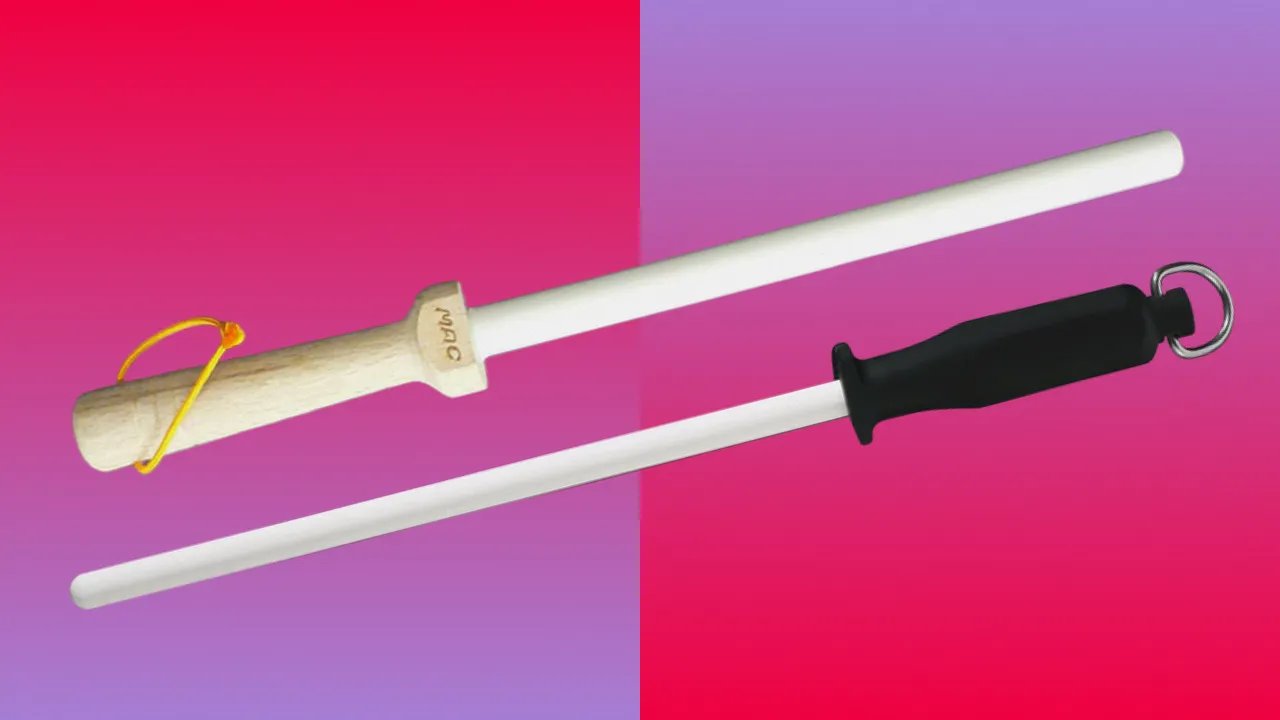
The best chefs live or die by the sharpness of their knives. Put on any cooking competition show, and you’ll likely see contestants whip out a honing rod to touch up their edge right before they dig into their prep. This doesn’t actually sharpen the knife, but it straightens out the very thin edge and helps it cut better, kind of like fixing a bent paperclip.
Not all honing rods work the same way, though. The right one depends on how hard your knife steel is. Softer rods are fine for basic knives, but harder, high-quality steel blades need a ceramic rod because it’s gentle enough to realign the edge without damaging it. More on all that below.
The process of honing a knife works in different ways for different types of steel. When knives are forged, knife makers heat the steel to super-high temperatures (between 1,500ºF and 1,800ºF), and then it’s rapidly cooled to force the molecules to realign into a harder state. As a knife hardens, it becomes more rigid, but also more brittle. A knife with a higher Rockwell Hardness Scale rating (around 60–61) will keep its edge longer because the metal resists deformation. You can chop as much as you want on a cutting board and the edge will remain straight and true. But because it’s more brittle, it’s also prone to chipping, especially when cutting something particularly hard, like frozen food or bone (which you shouldn’t do with a kitchen knife anyway).
Knives made with softer steel (around 56–58 on the Rockwell Hardness Scale) will still hold an edge, but are more likely to dent, fold, or bend rather than chip. Even repeated use on a cutting board will eventually cause the edge to roll over slightly. For softer knives, a steel honing rod can reshape and straighten out any deformities on the edge. But it won’t have much of an impact on harder steel. You need something stronger.
That’s where ceramic honing rods come into play. Ceramic honing rods are similar to a fine-grit whetstone, and the material is actually harder than steel. Because of that, honing with a ceramic rod will actually remove a bit of the metal from your knife with each pass, leaving your blade feeling freshly sharpened in a way a steel rod won’t.

Messermeister
12-Inch Ceramic Sharpening Rod
A ceramic honing rod isn’t going to turn a dull knife into a prime slicer, but a few passes before daily use will refresh your edge almost as if you were polishing the knife on a fine-grit whetstone and can potentially space out your sharpening needs by months.
