


We may earn revenue from the products available on this page and participate in affiliate programs. Learn More ›
Granite countertops are often sealed at the time of installation, but if it’s been a while since yours were installed, it might be time to reseal them. Improper cleaning, neglected spills, and other effects of everyday use can easily mar their surface. A quality penetrating or impregnating sealer will soak into the granite, filling the porous gaps, and keep damage at bay. True, a sealant only buys you time—unattended spills will seep into sealed granite eventually—but the right product, and the following steps for how to seal granite kitchen countertops, will help protect your investment.
Ahead, you’ll find general guidance for how to seal a granite countertop, but bear in mind that specific directions vary according to brand and active ingredients. It’s crucial to follow the instructions on the sealant you buy in addition to these handy guidelines.
How to Tell if Granite Needs Sealing
Your granite counter may be protected now, but it needs to be resealed every once in a while. The matter of how often to reseal granite depends on a few factors, such as the granite type and finish, how frequently it’s used and cleaned, and the application and quality of its existing sealant.
While granite is among the most-durable types of countertop materials, your counter might still need to be resealed every 1 to 5 years. More-porous granite with a smooth, honed finish that has been poorly sealed and maintained may need to be resealed every 1 to 2 years. A less permeable type of granite with a glossy finish, proper sealing, and regular maintenance may not need to be resealed for 3 to 5 years.
Here are a couple of surefire ways to know when it’s time to seal granite again:
- It fails the water and oil test. Somewhere inconspicuous, like in a back corner of the counter, put a few drops of water on the countertop, and a few inches away, apply a few drops of oil. After 15 minutes, check to see if the water or oil has seeped in and darkened the granite. If so, it’s probably time to reseal.
- The granite is stained. Look for any new stains in the granite. Granite stains can be identified by the discolored shapes they leave behind; these are often dark but sometimes take on the color of whatever caused the stain (e.g., red from wine, orange from rust, etc.). However, note that a lightened or rough-textured mark is indicative of etching, which is caused by a chemical reaction rather than absorption.
What to Know Before Sealing Granite Countertops
You have options when it comes to countertop sealants. Water-based countertop sealants are environmentally friendly, while solvent-based sealants may be a little better at penetrating the stone (though this level of penetration is arguably only important on polished granite).
When you’re shopping for the best granite sealer, check the labels of both water- or solvent-based sealants for the active ingredient fluorocarbon aliphatic resin. Though the product will be more expensive than those containing agents such as siloxane and silicon, fluorocarbon aliphatic resin typically provides 5 to 10 years of protection, versus the 6 months to 3 years provided by other sealants.
What’s more, fluorocarbon aliphatic resins repel oil and water, so your granite won’t be ruined by a salad dressing mishap. A quart of fluorocarbon aliphatic resin sealant, such as StoneTech BulletProof Sealer, costs about $47 and covers 100 to 250 square feet, depending on the brand. A 24-ounce spray bottle of lesser solvent runs around $15 but might require reapplication every 6 months or so.
Materials and Tools
Tools & Materials
Bobvila.com may earn a commission from purchases made through these links.
How to Properly Seal Granite Countertops
Sealing granite tops isn’t particularly difficult if you prepare carefully.
Step 1: Clean and dry the countertop.
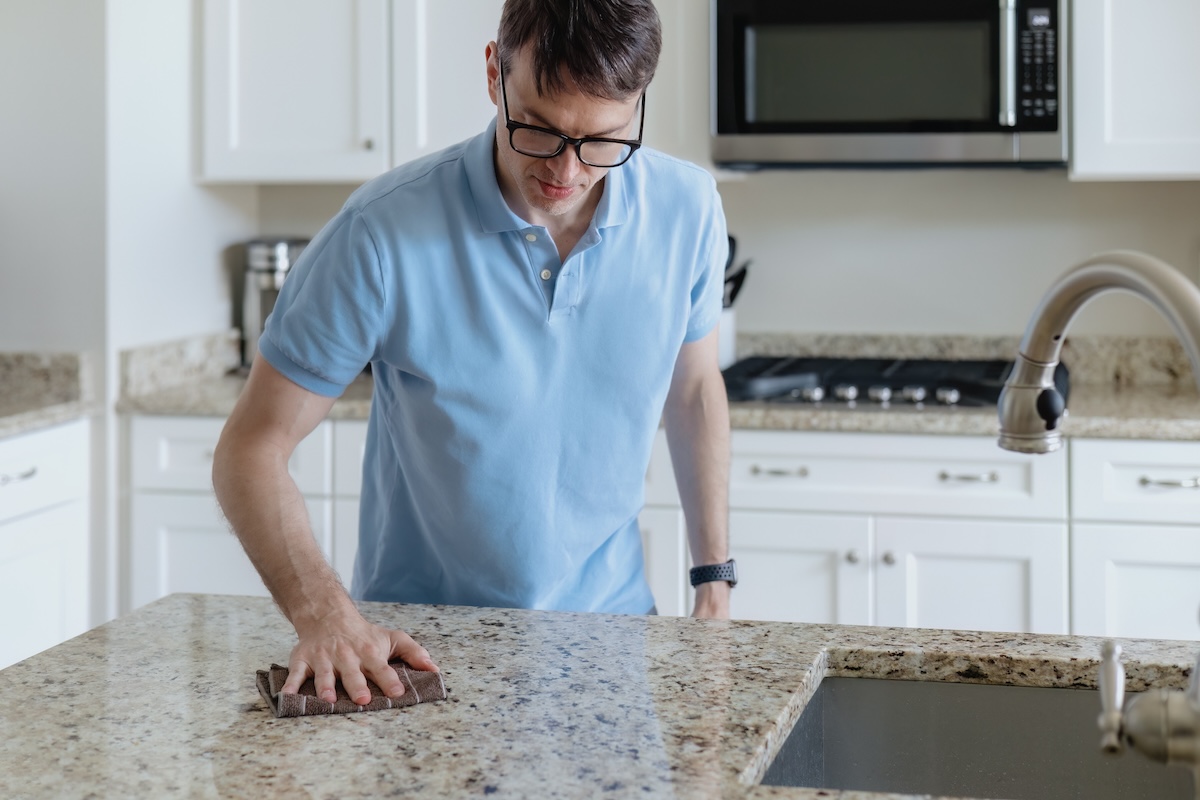
Prepare your kitchen surfaces for sealing by thoroughly cleaning the countertops 24 hours before sealing them.
- Take everything off the counter and wipe it down well with a clean, dry microfiber cloth to remove all surface dust.
- Mix 1 teaspoon of dishwashing detergent and 2 tablespoons of isopropyl alcohol in a pint spray bottle and fill with cool water.
- Do not use vinegar, lemon juice, baking soda, bleach, or harsh commercial cleansers.
- Generously spray the countertop with your detergent and alcohol mixture, and wipe it clean with a microfiber cloth, polishing in a circular motion.
- Wipe the countertops with a clean and dry microfiber cloth.
- Allow the counters to air dry for 24 hours before moving to the next step.
Step 2: Prepare to apply the sealant.
Read the granite sealer’s label thoroughly to understand the application method. Should our instructions vary from the label, defer to the manufacturer. Open windows and doors for improved ventilation. If it’s raining, do not open windows that could allow rain to hit the countertop; instead, open windows in other areas of the room or in adjacent rooms.
Step 3: Test the sealant in an inconspicuous spot.
Put on rubber gloves and grab some soft rags or washcloths. In an area usually covered by a small kitchen appliance, test the sealant to ensure it won’t affect the finish. Spray or pour a small amount per manufacturer’s directions onto a cloth and then rub it evenly over the test area.
Wait the recommended time for the sealant to absorb into the granite (usually 15 to 20 minutes, but sometimes much longer). Don’t let it sit longer than recommended because that could discolor the stone.
Step 4: Check the test area and, if necessary, reassess.
Make sure the test area looks and performs as you expect it to.
- Check for any discoloration, including dark spots or blotches.
- Look for cloudiness or haze.
- Some sealers may “enhance” the granite’s color; check for such effects.
- Place a few drops of water on the test area. If the water beads up instead of soaking in, the sealer is working.
If no problems exist and the sealant repels water, you can proceed to the next step. If the sealant did not perform as expected on the test area, snap photos of the area and show them to an associate at a home improvement center for advice on a more appropriate product. Once you’ve acquired a new sealant, clean the counter again and test the new sealant in a discreet spot.
Step 5: Seal the countertop.
If the test was successful, apply the sealant over the entire counter.
- Start at one end and work your way to the other.
- Apply in sections in a circular motion (about an arm’s length in diameter) to ensure consistent coverage.
- Use a clean sponge, cloth, or spray bottle to spread an even layer.
Wait the manufacturer’s recommended time for the product to absorb into the countertop.
Step 6: Wipe off excess sealant and allow it to cure.
After the absorption period has passed, wipe off any extra sealant with a clean, dry rag by rubbing in a circular motion. Some products require a second coat, so follow the instructions for doing so.
If the product you use requires only one coat, allow it to cure, which can take between 2 and 48 hours. Granite experts recommend waiting 48 hours before wiping a newly sealed granite countertop with anything wet. Avoid returning kitchenware to the counter until after the curing period.
Once the countertop has fully cured, put your kitchen back in order.
How to Maintain Granite Countertops
Learn how to treat granite counters in order to extend their lifespan.
- Keep the spray bottle of cleaner you created on hand for periodic use every month or two.
- For daily cleaning, a dab of dishwasher detergent and a wet rag or soft sponge will get the job done beautifully.
- Strive to wipe up spills immediately and keep the countertop dry to keep your granite looking great.
- Use cutting boards and coasters to protect the surface.
FAQ
Granite countertops should be periodically resealed to keep them beautiful and durable. Dark-colored granite is less porous than lighter colored stone, and might not need resealing as frequently.
You can seal granite countertops yourself, provided you follow the above instructions carefully.
For best results, choose a sealant that contains fluorocarbon aliphatic resin. You’ll find water-based sealants that are environmentally friendly, and there are also solvent-based sealants that can be a bit better at permeation. Choose the one that makes the most sense to you.
You might need to reseal your countertops in as little as a year, or you might not have to do it for as long as 5 years. The type of granite, the usage frequency, the cleaning history and the quality of the current sealant all factor into how often you’ll have to reseal your granite countertops.

I Was Dead Set On Stone Floors—Until I Saw These Options
