


Public health specialists from the UK are being deployed to central Africa to help respond to the unfolding Ebola outbreak in the region.
The UK Health Security Agency (UKHSA) is deploying members of the UK Public Health Rapid Support Team (UK-PHRST) to the Democratic Republic of Congo (DRC) and surrounding area.
“We now urge the global community to move quickly to support nurses and health systems”
Marcus Wootton
The move comes a day after the Royal College of Nursing described the outbreak as “deeply concerning” and called for a coordinated international response.
UK-PHRST, set up after the 2014-15 West Africa Ebola outbreak, works with low- and middle-income countries to respond and prepare for infectious disease outbreaks and public health emergencies.
The UK has also committed up to £21m to support the government-led Ebola response in DRC to support a locally led response, helping to protect frontline workers and vulnerable communities.
Dr Edmund Newman, director of UK-PHRST, said: “This deployment will help strengthen the existing response to the Ebola outbreak in the DRC and across the region.”
It will mean experts in epidemiology, risk communications and community engagement, infection prevention and control and data modelling are “on the ground” to provide support, Dr Newman said.
“We know infectious diseases are not restricted by borders, which is why it’s vital we continue to work collaboratively with the World Health Organization and other international partners,” he said.
Jenny Chapman, minister for Africa and International Development, said: “UK-PHRST brings world-class expertise, from infection control to community engagement and modelling the data.
“It demonstrates our commitment to global health security, and supporting the African-led response to this crisis,” she said.
Meanwhile, on Monday, the RCN warned that without help to support health authorities in the region, including steps to prevent shortages of essential supplies, the situation could worsen further.
It said the Ebola outbreak was already putting fragile health services and nursing staff at risk and adding pressure to surveillance, testing, contact tracing, and clinical services in the region.
At the beginning of June, the International Council of Nurses (ICN) warned that nurses were being put at serious risk and left in fear, partly due to shortages of personal protective equipment (PPE).
The RCN said it was joining the ICN in calling for frontline staff in the DRC and surrounding nations to have immediate access to high-quality PPE, screening equipment and other protection.
The college said it had also worked with nursing experts to collate and provide evidence-based Ebola Treatment protocols, which have been shared with a large network of nurses working in the region.
It warned that the current outbreak was particularly challenging because the virus was not presently identifiable through standard lab testing, nor was there an approved vaccine or specific treatment.
The RCN’s International Academy associate director, Marcus Wootton, said: “We are deeply concerned by the worsening Ebola situation and by the pressure now being placed on nursing staff.
“There have been Ebola outbreaks before and the nursing profession knows what needs to be done this time to provide high-quality care to patients,” he said.
“We now urge the global community to move quickly to support nurses and health systems,” he said. “This outbreak shows why sustained investment in global health matters.
“When surveillance, infection prevention, staffing and basic supplies are weak, outbreaks become harder to contain, and nurses and others carry the risk,” added Mr Wootton.
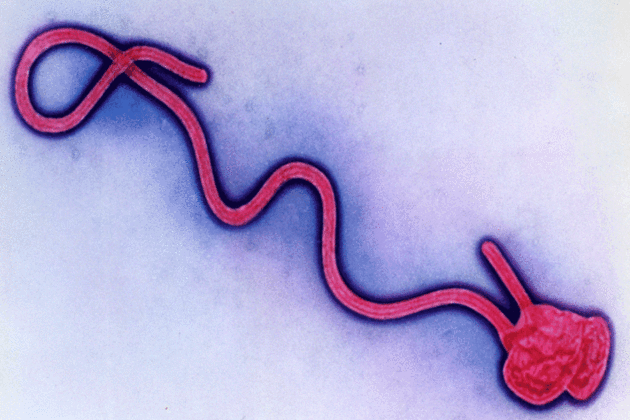
An Ebola outbreak involving the Bundibugyo species of the virus was confirmed in the DRC and neighbouring Uganda in May by the World Health Organization.
According to latest figures from the WHO, as of 15 June, there have been 827 confirmed cases of Ebola in the DRC and Uganda, and 194 confirmed deaths. Most of the cases have been in the DRC.
