



As a parent to two young children, I am a target client for universities everywhere. So far, I have saved over $800,000 in two 529 plans to pay for universities in 9 to 12 years. I know we need to pay full freight because we are nobodies, but make above the low income limit to receive free or heavily subsidized tuition.
As a potential customer spending this much money, I logically do extensive research. If the benefits don’t outweigh the costs, I won’t buy the product. We do this analysis with cars, electronics, homes, vacations, and stocks. College should be no different.
With the advancement of AI and the explosion of free information online, the value proposition of a college degree is declining. I don’t understand why it still takes four years to earn a degree when technology has accelerated knowledge acquisition so dramatically. A standard three-year path to graduation seems far more appropriate given where we are today.
I also don’t understand why tuition continues to rise far faster than inflation as the value of a degree comes into question. Every college administrator and professor I have spoken with says they want to educate young people and make them better prepared for the future. If that is truly the mission, why not reduce tuition to make college accessible to more families rather than fewer?
And why don’t top universities progressively expand their class sizes to match demand? If the goal is to help as many people as possible, it makes sense to aggressively grow capacity when acceptance rates are already well below 20% at most of these top 50 universities.
Finally, why don’t colleges guarantee their graduates a minimum level of employment income? If they truly believe in the quality of their education, standing behind their product with an employment guarantee should be a natural extension of that confidence.
We All Know Why Colleges Are Slow To Changing
I am being a little dishonest when I say I don’t understand why universities aren’t evolving. The real reason is straightforward. Colleges, operate as businesses, whether they are nonprofit or for profit. They need to take in more than they spend to keep the lights on.
Lowering tuition hurts operating budgets. So does letting in fewer international students who tend to pay full tuition. Expanding class sizes dilutes prestige.
Guaranteeing employment paying a minimum level for graduates is a risk no institution is willing to take because deep down, they are not confident enough in their own product to back it with a guarantee.
If you don’t run a business well, you will lose out to your competitors and may have to eventually shut down. No university wants that.
The Cost Is a Great Sacrifice for Parents
Despite the declining value of a college degree, more parents than ever are sacrificing their retirement savings and working longer at jobs they dislike just to send their children to college.
Personally, I’m still driving an 11-year old car with about 20 dents and leaky coolant I just can’t seem to fix, in order to continue saving for my children’s education. It would be awesome to grind less and enjoy my wealth more, but looking college tuition bills are weighing me down. Maybe the same is for you, as you could retire years earlier if it wasn’t for the burden of college tuition.
Meanwhile, the growing threat of AI has created a real fear that without a degree, their children will get trapped in the permanent underclass and end up financially dependent on their parents in adulthood.
The irony is profound. A child can spend over 20 years in school, from preschool through college graduation, and still end up underemployed or unemployed. After being told for a decade to “learn to code,” many graduates entered the workforce only to discover that advice was already outdated.
Children sacrifice their high school years grinding for grades, test scores, and extracurricular activities just for a chance at admission. They start nonprofits to save hungry children and volunteer abroad to save malnourished adults. Then they get to college and pivot entirely toward technology, consulting, or banking because that is where the money is.
Is money and prestige really the end all be all?
After graduation, if they are lucky enough to land one of those high paying jobs, many spend the next 20 to 30 years miserable in careers that were never their passion. The money is too good to walk away from, so they stay on the treadmill and eventually raise their own children to do the same thing.
If only college were a better deal.
Colleges Are Advertising Jobs For H-1B Visa Holders
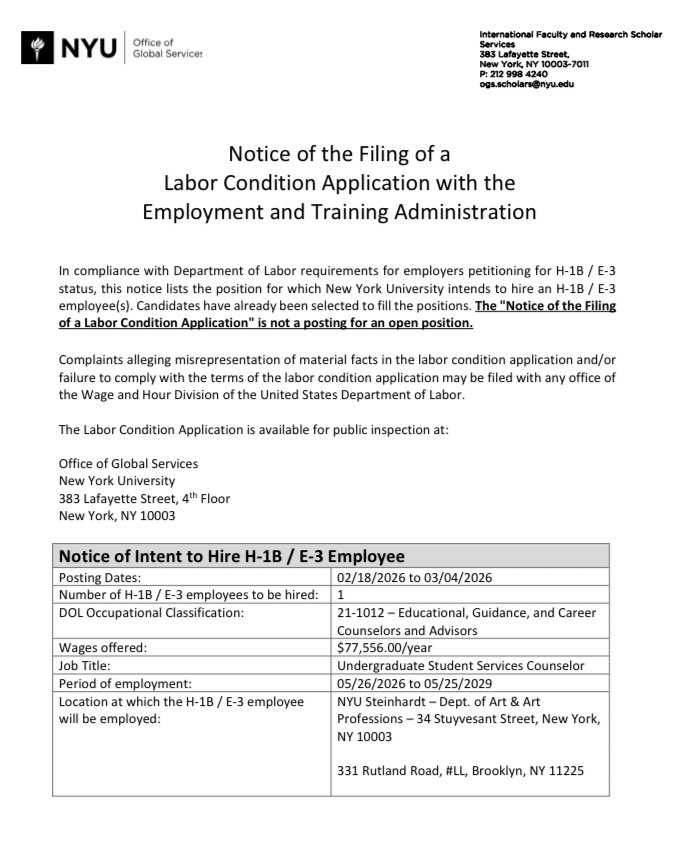
I recently learned through an independent journalist, Chris Brunet, that many well-known universities have been posting jobs that appear to target H-1B visa holders instead of hiring Americans from their own graduate pools.
Here is an example from the University of Virginia, which hired an H-1B worker for a Data Analyst position paying $80,576. UVA’s School of Data Science reportedly graduates roughly 200 undergraduates a year, along with another ~140 students from its master’s and related programs.
Meanwhile, UVA graduates about 4,600 students a year from its undergraduate program alone.
So you’re telling me that out of thousands of graduates, including hundreds trained specifically in data science, UVA couldn’t find a single candidate to fill a Data Analyst role? Come on now.
I understand the importance of making money. But shouldn’t colleges and universities put more emphasis on education and supporting their students?
Tough Labor Market For New College Graduates Already
In an environment where college graduates are struggling to find work and AI is displacing knowledge workers at an accelerating pace, you would think universities would be doing everything possible to place their own graduates. Reading the room is a standard skill.
However, by publicly advertising jobs for H-1B visa holders, a college is effectively telling the world that its own American graduates are not qualified to fill those roles.
The logical conclusion for prospective students and parents like me is to factor this into the decision of whether to apply at all.
Because the cost is not just the $30,000 – $80,000 / year in tuition today. It is also four years of your child’s life and the opportunity cost of everything else that money could have done.
Saving Money Is More Important Than Anything
The other explanation for why some American universities don’t just hire their own American graduates is simpler and more cynical. Colleges would rather hire cheaper foreign labor than pay market wages to American workers.
They have calculated that the cost savings outweigh any reputational damage or lost tuition revenue from families who choose to look elsewhere. In a free market, they are entitled to make that call. But families are equally entitled to take note and respond accordingly.
As investors, we accept that companies like Google and Amazon lay off thousands of American workers and replace them with H-1B workers all the time to save money. If these new employees are just as productive at a lower cost, profit margins naturally expand, making investors rich.
However, colleges themselves are not investments. If they accept taxpayer dollars, they should probably focus more heavily on admitting and hiring Americans.

How to Decide Which College Is Worth the Money
Given all of this, how should families actually approach the college decision? Here is the framework I use and recommend.
Follow the one-fifth rule on net tuition cost.
Only seriously consider a college where the annual net tuition cost per child is no more than one fifth of your gross household income, but preferable one-seventh or less.
If your household earns $250,000 a year and a private university costs $60,000 a year net of financial aid, that school fails the test. You need to earn more than $300,000 a year to afford it without jeopardizing your own retirement. An in state public university at $28,000 a year passes comfortably. This single filter eliminates most financially reckless decisions before they happen.
Focus on net cost, not sticker price.
The published tuition rate is largely meaningless. What matters is what you will actually pay after grants, scholarships, and other free financial aid. Use the Net Price Calculator that every accredited university is required to publish on its website. Run the numbers before your child falls in love with a school.
Research graduate employment outcomes by major.
Do not evaluate a college in the abstract. Evaluate it by the specific program your child plans to study. A computer science degree from a strong state school may produce better employment outcomes than a humanities degree from a prestigious private university. Look up median starting salaries and employment rates for graduates of the specific department, not the institution overall.
Look at what the school actually does, not what it says.
This is where the H-1B hiring data becomes directly useful. If a university is advertising roles for H-1B visa holders rather than recruiting its own American graduates, that is a signal worth taking seriously. It suggests the school either does not believe its graduates are qualified for those roles or does not feel enough obligation to its alumni to prioritize them. Neither interpretation reflects well on the institution.
Before applying, look up the university’s own job postings. If you see H-1B specific listings or roles that should be well within reach of their graduates going unfilled by alumni, ask yourself why. A school that does not hire its own alumni is telling you something important about the confidence it has in its own education.

Consider the debt-to-income ratio at graduation.
A useful rule of thumb: total student loan debt at graduation should not exceed the expected first year salary in your chosen field. If a nursing graduate expects to earn $65,000 in their first year, they should not graduate with more than $65,000 in debt. If the math does not work, the school is too expensive for that career path.
Do not overlook community college and transfer pathways.
Two years at a community college followed by a transfer to a four year university can cut the total cost of a degree by 40% to 50% while producing the same diploma. Many employers care about the name on the degree, not where the first two years were spent. This path is underutilized and underappreciated.
How to Pay for College Without Destroying Your Finances
Once you have identified schools that pass the value test, the next question is how to pay for them without derailing your retirement or burying your child in debt.
Start a 529 plan early and contribute consistently.
A 529 plan grows tax-free and withdrawals are tax-free when used for qualified education expenses. Time is the most powerful variable. $5,000 a year invested starting at birth grows to over $150,000 by the time a child turns 18 at a 7% annual return. Start as early as possible, even if the contributions are small.
Under current rules, unused 529 funds can be rolled over into a Roth IRA for the beneficiary, up to $35,000 lifetime, subject to annual Roth contribution limits. If your child earns scholarships, attends a lower cost school, or skips college entirely, the money is not trapped. Plan accordingly.
Do not sacrifice your retirement to pay for college.
This is the most common and most damaging financial mistake parents make. You can borrow money for college. You cannot borrow money for retirement.
If fully funding a 529 plan means you are not maxing out your 401(k) or IRA, prioritize retirement first. A financially secure parent is ultimately more valuable to a child than a fully paid college education. Please especially be careful of sabotaging your retirement for private grade school.
Apply for financial aid even if you think you won’t qualify.
The FAFSA and CSS Profile determine eligibility for grants, scholarships, and subsidized loans. Many families assume their income disqualifies them and never apply. That assumption costs real money as there is plenty of free money for college. Always submit the forms and let the numbers speak for themselves.
I know families making multiple six figures a year who receive free financial aid. Bloomberg did an analysis highlighting that households who earn up to $350,000 a year can get free financial aid. However, I know how enough households who earn over $500,000 a year who receive free financial aid, so don’t be shy in applying.

Have an honest conversation with your child about cost.
Too many families make the college financial decision without fully including the child in the conversation. Your child should understand what the school costs, what your contribution will be, and what their expected debt load looks like at graduation. That transparency leads to better decisions and more ownership of the outcome.
If your child is not an American nerd pulling significant merit aid to offset tuition, help them lower their expectations on which college to attend. Real money and lost time are at stake.
What I Am Hoping For When It’s Time To Pay For College
By the time my son graduates from high school in 2036, I am genuinely hoping that a traditional four year college experience will no longer be necessary. If that happens, I can redirect what may grow to $750,000 in his 529 plan toward helping him launch into adulthood in a more direct and meaningful way.
But the race between technology and traditional education moves slowly. Even as self-driving cars multiply on the roads, there are still plenty of drivers. I suspect when the time comes to make the college decision for my kids, the social pressure to attend a four year university will still be enormous, even if the economics have deteriorated further.
Over the next 9 to 12 years, I hope colleges begin hiring their own American graduates, which are ultimately their clients. I hope tuition assistance grows meaningfully so families do not have to sacrifice their financial futures for a degree whose value is uncertain. And I hope more families start doing the math before paying for college.
Knowledge work is being disrupted 100% by AI, and colleges are in the business of providing knowledge. The stakes of making a poor college decision have never been higher. Do the research, run the numbers, and make the school prove its value before you hand over six figures and four years of your child’s life.
Readers, why do you think colleges are advertising jobs for H-1B foreign worker instead of hiring their own American graduates? And as a potential consumer of higher education, what due diligence are you doing to make sure the cost is worth it?
Track Your Finances So You Can Make Smarter College Decisions
One of the best ways to navigate the rising cost of college is to understand your finances inside and out. When you know your net worth, asset allocation, income generation, and investment returns, it becomes much easier to determine how much you can realistically afford.
Track your 529 plan growth and overall finances with Empower’s free financial tools. Once you connect your accounts, you can monitor your net worth, track your portfolio allocation, and better understand your cash flow over time. The more clarity you have, the easier it is to make confident decisions about one of the biggest investments a family can make.
I recently went to the post office to send out a dozen signed copies of my USA Today bestseller, Millionaire Milestones. If you’re interested in participating in the promotion, you can read about my experience and the instructions in this post.
