


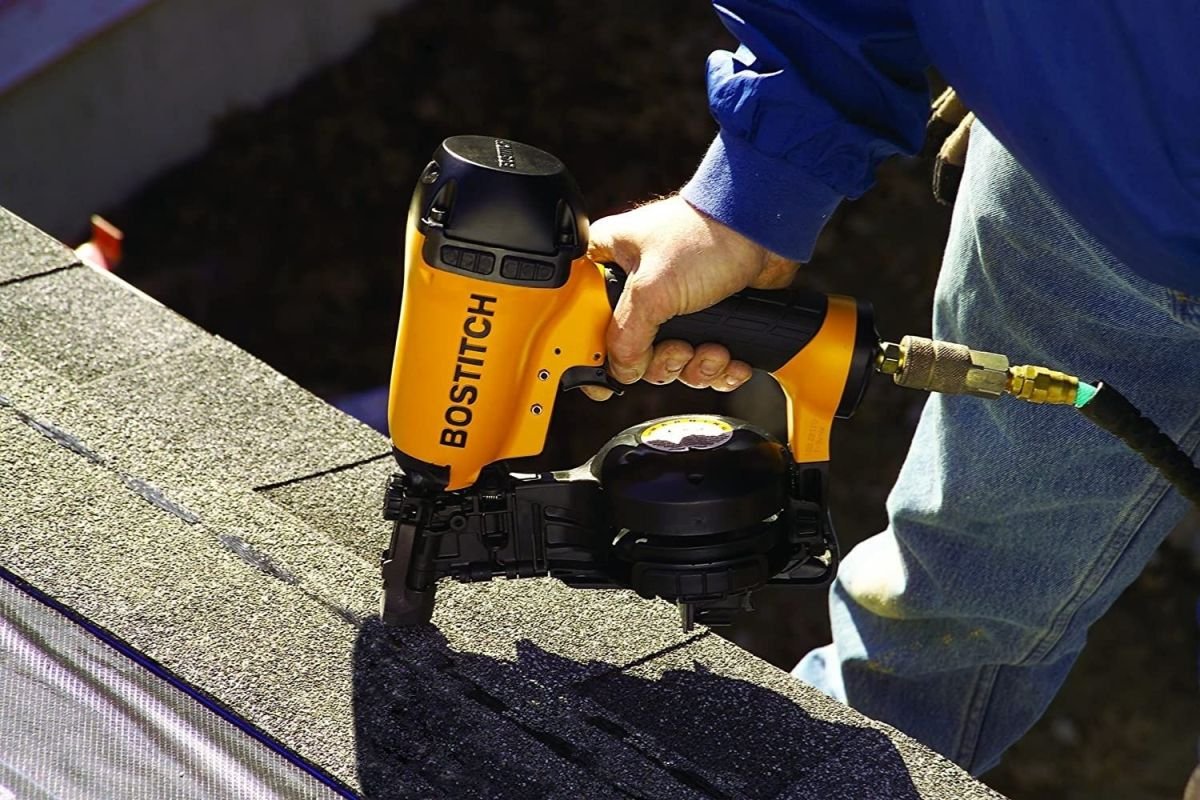
While replacing or repairing a roof can save you hundreds in labor costs, attempting a complete roofing job with a hammer isn’t efficient, especially when you consider that most roofs require at least four nails per shingle. There are generally about 240 shingles for every 100 square feet, which means that there are hundreds of nails in an average home’s roof.
Roofing nailers make installing shingles much more manageable. These roofing tools, which are powered by an air compressor and typically hold up to 120 nails, function similarly to other nailers with a trigger-operated mechanism that fires the nails through the roofing material. With their ability to fire more than 100 nails per minute, these powerful tools dramatically shorten the time it takes to complete a roofing job.
Whether you’re replacing a roof or just replacing an old roofing tool, read on to find out why the recommendations below are among the best roofing nailer options available.
- BEST OVERALL: Bostitch RN46 Coil Roofing Nailer
- BEST BANG FOR THE BUCK: Wen 61783 Pneumatic Coil Roofing Nailer
- ALSO CONSIDER: Metabo HPT NV45AB2 Roofing Nailer
Our Top Picks
The roofing nailers below feature durable construction, high nail capacities, and low-maintenance designs. They come from some of the best-known manufacturers in power tools, including Bostitch, Dewalt, and Metabo HPT.
Best Overall
Bostitch RN46 Coil Roofing Nailer
Photo: amazon.com
With its versatile design, high capacity, and easy reloading, this coil roofing nailer is suitable for both DIYers and professional contractors. It can fire both ¾-inch and 1¾-inch nails, and includes adjustable depth control, enabling it to handle a variety of roofing jobs. Five different depth settings allow it to execute flush mount, countersunk, and shallow nailing. Its aluminum build makes this roofing nailer both durable and lightweight, weighing under 6 pounds.
A high-capacity magazine holds 120 nails, speeding up the job by reducing the number of reloads. With its ability to fire up to 100 nails per minute, this is an excellent option for larger roofs. When it is time for more nails, reloading requires sliding open a door and replacing the magazine with a new coil. This nailer works with compressors operating from 70 to 120 psi.
Get the Bostitch roofing nailer at Amazon.
Best Bang for the Buck
Wen 61783 Pneumatic Coil Roofing Nailer
Photo: amazon.com
This affordable nailer makes putting a new roof on your home or shed a manageable job while keeping costs down. This model is about half the cost of other roofing nailers, but still offers excellent features, including a 120-nail capacity and an ability to handle ¾-inch to 1¾-inch nails.
An adjustable shingle guide turns nail spacing into a simple task for inexperienced roofers, while a toolless adjuster makes setting the proper nail depth easy. Other features help to minimize delays while working include a cartridge located on the unit’s side that slides out for quick reloads. A compartment near the tip allows you to quickly clear nail jams. Other highlights include an adjustable exhaust valve that lets you redirect the air away from your face and an ergonomic rubber grip that adds comfort.
Get the Wen roofing nailer at Amazon.
Also Consider
Metabo HPT NV45AB2 Roofing Nailer
Photo: amazon.com
Hitachi may have changed its name to Metabo HPT, but nothing has changed when it comes to the quality of this manufacturer’s tools. Whereas other nailers use plastic in their frame, the Metabo HPT features a sturdy aluminum build with a carbide tip. Despite its durable metal construction, it remains surprisingly lightweight at just 5.5 pounds, making it manageable to wield from a rooftop. Its ability to nail both ⅞-inch and 1¾-inch nails give it excellent versatility, while a drive adjustment dial allows for precision adjustments of nail depth.
With its ability to fire nails quickly—up to three per second—and large 120-nail capacity, this tool is an excellent option for daily use at a professional job site or for DIYers taking on bigger roofing jobs. Other convenient features include a toolless depth adjuster and a side-loading magazine that makes reloads fast. A rubber grip allows for a firm hold on this nailer, while rubber pads prevent it from sliding off the roof when not in use.
Get the Metabo HPT roofing nailer at Amazon.
What to Consider When Choosing the Best Roofing Nailer
When shopping for a roofing nailer, it’s critical to consider key characteristics such as nail capacity and length, safety features, air pressure range, and weight.
Nail Capacity and Length
It’s crucial to know what size nails you need before buying a nail gun. If your nails are too short, they won’t adequately hold your roofing to the house. If they are too long, the nails will stick through into the attic, creating a possible hazard for those moving around in the attic space. Most roofing nailers can handle ¾-inch to 1¾-inch nails.
Nail capacity can range significantly with roofing nailers from 60 to as many as 120 nails. Larger capacities are more convenient but do add weight to the nailer. Roofing requires a lot of nails, so most tool manufacturers make reloading their roofing nailers easy with magazines that slide in and out of compartments on the side of the unit.
Weight
Weight determines how easy it is to wield the nailer, which impacts accuracy, safety, and user endurance. A nailer that is more manageable to carry allows the user to make more precise nail placements, maintain a more stable balance on the rooftop, and work longer with less arm fatigue. Most nailers weigh around 5½ pounds, with some models weighing as little as 4½ pounds.
Air Pressure Range
A roofing nailer needs enough air pressure to drive the nail completely through the roofing material without damaging the material, roof, or nailer. Most roofing nailers demand a compressor that produces between 70 and 120 pounds per square inch (psi).
A psi that is too low will leave nails proud, sticking out of the roofing. A psi that is too high could drive the nail too deeply into the roof, damaging the shingles. It can even cause jams that can damage the nailer. Some roof nailers feature a convenient dial that allows you to adjust nail depth, eliminating the need to climb down a ladder to make pressure adjustments on the air compressor.
Safety Features
Like finish and framing nailers, roofing nailers are among the more dangerous power tools one can use. With that in mind, most models come equipped with safety features designed to reduce the likelihood of accidents.
All roofing nailers feature a tip that the user must press to fire nails. This prevents you from accidentally firing nails into the air. Some nailers also feature switches that allow you to toggle between bump firing, which causes the nail to fire every time the tip is pressed, or safer single-shot firing, which requires the user to pull the trigger to fire each nail.
Most nailers also have lockout switches that prevent the tool from firing either accidentally or when the trigger is unintentionally engaged. Another safety feature many nailers incorporate is rubberized sides to help prevent the nailer from sliding off a roof and potentially injuring someone below.
Handle
Replacing a roof is a long process that involves firing hundreds, if not thousands, of nails. A nailer with an ergonomically shaped handle and soft, rubberized grips reduces hand fatigue while also ensuring the nailer doesn’t slip out of the user’s hand and tumble to the ground.
FAQs
If you’re still wondering about roofing nailers, then read on for answers to some of the most common questions about these tools.
What is the difference between a siding nailer and a roofing nailer?
Though they may look very similar, they cannot be used for the same purpose. Roofing nailers use different nails than a siding nailer. Roofing nails are about 1¾ inches long, while siding nails are approximately 2½ inches long. This means siding nails won’t fit into a roofing nailer.
What size air compressor do I need for a roofing nailer?
Air compressor output is measured in cubic feet per minute (CFM). Because they fire longer and thicker lower-gauge nails, roofing nailers need a higher CFM than finish nailers. You need a 4.0 CFM air compressor to power a roofing nailer, which equates to a model with a 6-gallon tank.
Which is better: roofing nails or staples?
While both staples and roofing nails offer the same level of wind resistance, roofing nails are generally easier to install correctly. This is because staples must be installed with the crown parallel to the length of the shingle. This can be tricky when maneuvering on a roof. Since roofing nails have round heads, there is no need to orient the head.

The Best Holiday Gifts for 2025
