


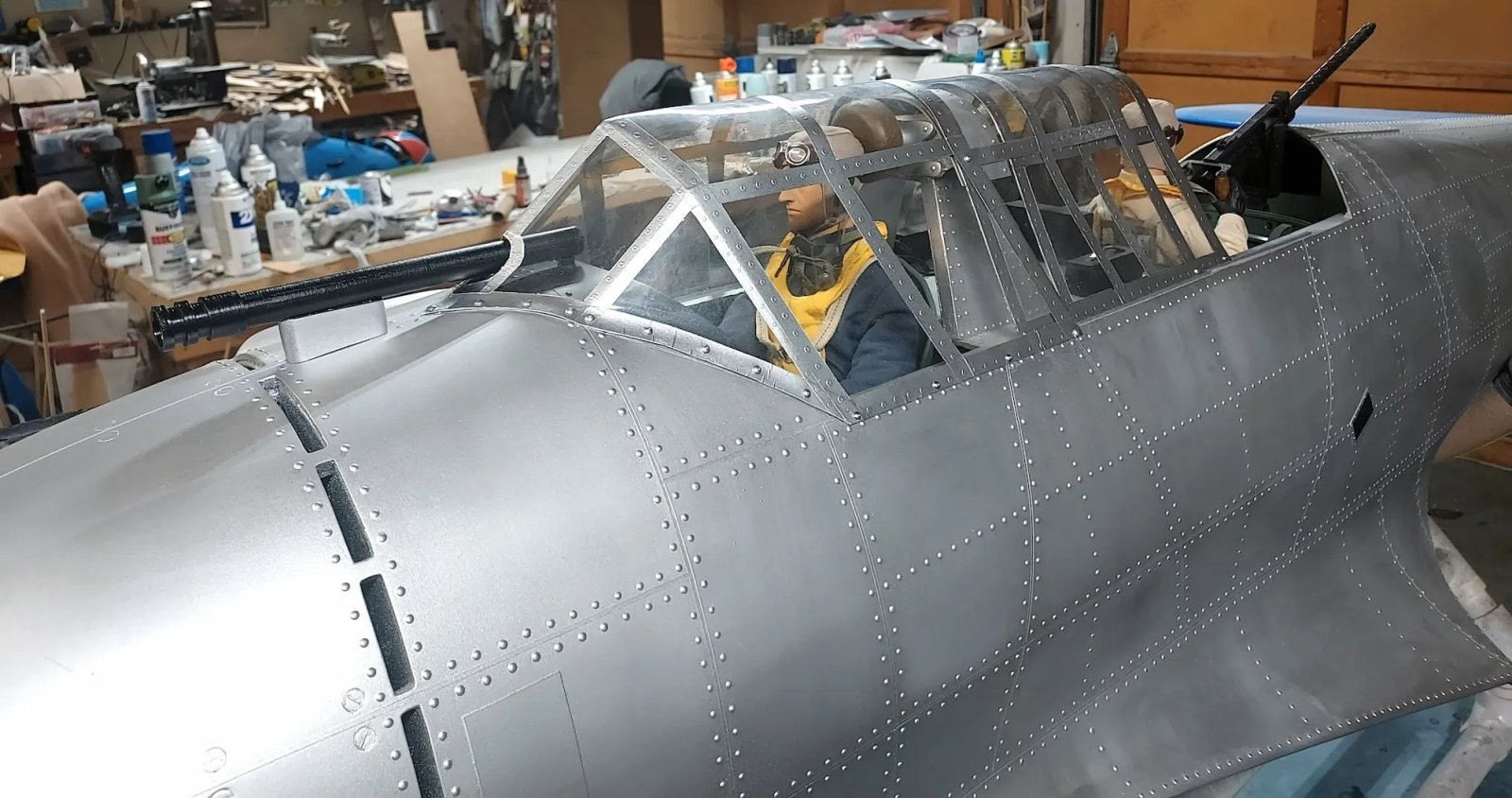
Metal panels on full-sized aircraft are attached in a variety of ways. Some panels butt against each other with no space between. Others, like the Mustang, have noticeable gaps exposing chromate primer below. Racing planes and sailplanes tend to have putty between the panels and over flush rivets, making them nearly invisible. Major stress junctions require overlapping panels. Panels are usually outlined with flush rivets or round-head rivets, but some modern airplanes have panels glued in place.

Fabric surfaces are typically reinforced with stitches around the stringers or ribs and covered with cloth tape. Rib stitches on wings have to be strong enough to support the weight of the aircraft. Fabric on fuselages and other non-lifting surfaces generally don’t require stitches but they may be smoothed and reinforced with a layer of tape over the stringers. Spacing between stitches varies from 1 to 3 inches on the full-sized aircraft, depending on expected air speed.
For best results, examine close-up photos of the airplane being modeled to determine the type of surface detail—flush or round rivets, overlapped or abutted panel lines, pinked-edge tape or straight, etc. If not available, seek pictures of a similar aircraft. Best of all, visit your local air museum. See and feel the surface. If the museum guard asks why you are fondling his airplane, tell him you are a scale modeler. He will understand.
Panel lines
After covering the surface with glass cloth or other material, lay down one coat of sandable primer. Sand off almost all of it, leaving a smooth surface.

Using scale three-views and photos as references, draw panel lines on the surface with a flexible straight edge and a fiber-tip pen.

Lay one-inch wide masking tape beside each panel line and then lay 1/32” Chartpak or other masking tape on the panel line. Snug the tape against the wider masking tape for a straight line. Remove the wider tape, leaving only the Chartpak tape.

Apply another coat of primer with a mini-roller. Sand off almost all of it, leaving the Chartpak tape exposed.
Remove the Chartpak tape. Ball up and remove any remaining Chartpak adhesive from the panel lines with a rubber squeegee. Sand the edges very lightly to remove flashing.

For overlapped panels, apply one or more layers of regular masking tape and apply primer over one edge of the tape. When dry, remove the masking tape and lightly sand the edge.

Sometimes prominent hatches, such as gun covers, require a surface too thick to be implemented with primer. In this case, mask off the hatch with more than one layer of masking tape, apply a thin layer of Bondo or other automobile body putty with a squeegee or credit card, and sand to the tape. Remove the tape and lightly sand the edges.
Rivets
Round-head domed rivets appear on highly stressed surfaces such as wing fillets and landing gear doors. They are stronger than flush rivets but create more drag. Real aluminum miniature rivets are available from MicroFasters. Just drill holes and glue them in.
Flush rivets and smaller round-head rivets can be simulated with yellow glue, thinned with about 20% water. Rivet tape can be purchased from Scale Model Products.
Attach the rivet tape. Apply a 20% diluted solution of white or yellow glue. For flush rivets, squeegee off the excess with a credit card. For domed rivets, place a drop of glue over each hole and don’t squeegee. Remove the tape immediately while the glue is wet. The rivets will appear to be too large at first but they will shrink as the glue sets.
Pop rivets have a hole in their centers. If the glue is diluted even more and just right, it will wrinkle slightly when drying, creating a pop-rivet look. This requires some experimentation to get right—try it on a scrap surface first. Rivet tape can be reused but only once or twice.

Small hatches can be made from aluminum Duck Tape. Cut to size and apply. Wet-sand with 600-grit sandpaper to remove high spots. Flush rivets can be embossed into the aluminum with a sharpened brass tube. Run a #11 X-acto blade around the inside edge of a brass tube to sharpen its edge, press the tube into the duct tape, and rock the tube in a small circular motion. Flush rivets can also be embossed into primer by this method if the primer is thick enough.
Stitches
If you are a balding middle-aged man purchasing 15 rolls of Scotch Hair Set Tape at the drugstore or beauty shop and you are asked what you are using it for and you say you are building a quarter-scale Stearman, the clerk won’t understand unless of course the clerk is also a scale modeler. Then you will receive a knowing grin of understanding.
Begin by making a rib-stitching tool. Squash the end of a ¼” aluminum tube with a pliers. Don’t completely close the end. Leave a thin slit. Prepare a solution of white glue diluted about 20% with water in a bottle to a depth of about one inch. Dip the tube into the bottle, squashed end first, pause, then place your thumb over the open end. Remove the tube from the bottle and wipe the outer surface with a paper towel.

Lay a ruler next to a rib and touch the tip of the glue pen to the surface, rocking slightly side-to-side. Repeat, moving the pen by a measured amount. The glue pen will make 10-20 stitches before refilling. If you make a mistake, remove the glue with a damp towel and try again. The stitches will look too big at first but they will shrink as the glue dries.

Scotch Hair Set tape is about right for quarter scale. Apply it or other pinking tape (see References) over the rib stitches. Apply nitrate dope to Scotch Hair Set tape to secure the tape and to raise the fibers. Sand smooth.
The Focke Wulf TA 152H; and other fast warbirds typically have stitched fabric only on their control surfaces, but many classic airplanes such as the Howard Pete also have fabric-covered fuselages in which tape without stitches is used over fuselage stringers.
The Hawker Hurricane is typical of airplanes having fabric-covered fuselages. They tend to have closely spaced stringers without stitches or visible taping. These stringers can be simulated by placing 1/32” or 1/16” 3M masking tape on the fuselage sheeting before covering with fiberglass cloth. The result is only a slightly bulging line.

Phillips pan-head and flat-head screws appear on the Grumman Lynx and other modern airplanes. The best way to simulate screw heads is to use real screws. Miniature screws in a large variety of styles and sizes are available from MicroFasteners.
Reprinted from the book Model Airplane Construction Techniques With Emphasis on Giant Scale.
For more scale how-to articles and free plans, visit www.mnbigbirds.com.
Good building!
References:
http://www.personainternet.com/scaleribstitch
http://rcscaleproducts.com/products-page/finishing/rivet-tape-16th-15th-and-14-scale
