


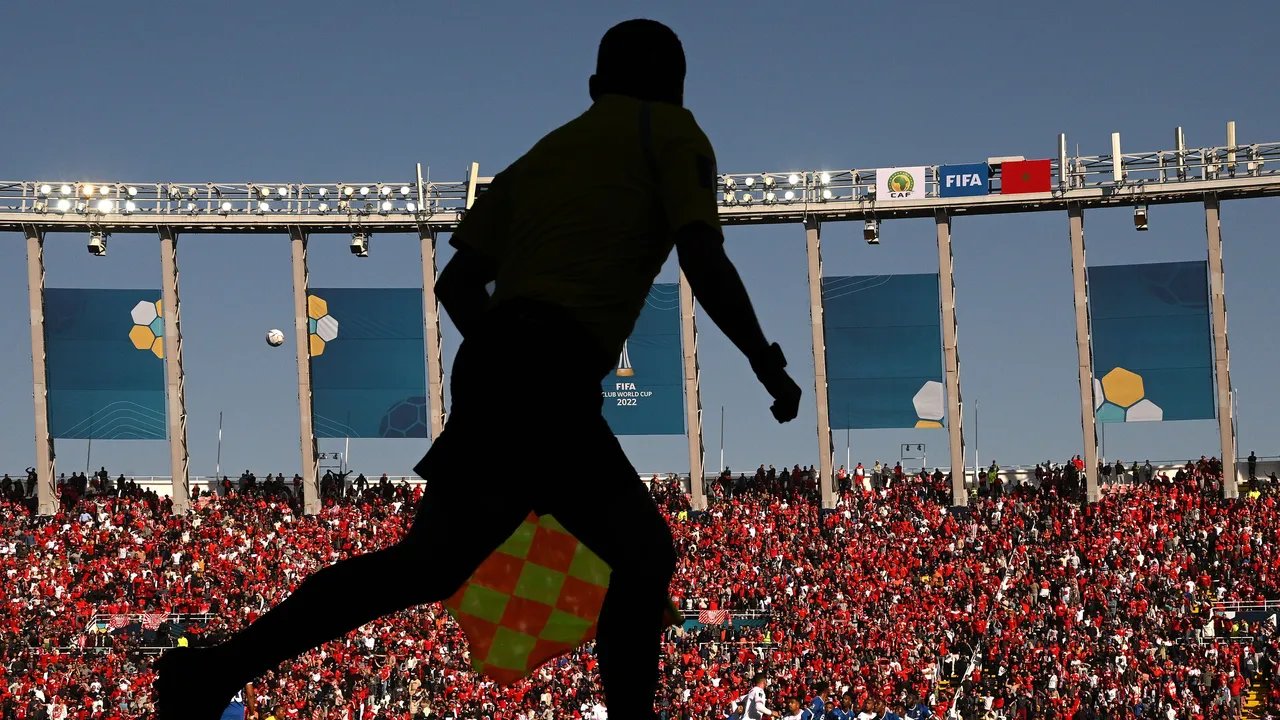
There is no better time to see either team play than on Casablanca derby day, when they face off against each other in their home city. As the players emerge from the tunnel of Stade Mohammed V and onto the pitch, the “Donor” (the stadium’s local nickname) undergoes a metamorphosis. To the north, the Curva Nord section erupts in a tidal wave of carmine red, the colors of Wydad AC. To the south, the Magana Curve answers with a defiant, shimmering wall of emerald green, the badge of Raja CA. “Casablanca has one of the most passionate football cultures in the world,” says Omar Boumeshoul, a Raja CA fan based in the city. “Wydad AC and Raja CA have the biggest rivalry, and both are based in Casablanca, splitting the city into two. You’re either dima Raja or dima Wydad.”
That passion has expanded far beyond Casablanca in recent years thanks to the Moroccan national team’s performances on the world stage. The team’s historic run at the 2022 FIFA World Cup saw Morocco become the first African and Arab nation to reach the semi-finals, beating football giants Portugal and Spain. That moment didn’t just make history, it reshaped expectations of what was possible—and briefly unified rivalries like Wydad’s and Raja’s into a single national voice.
“It felt like the whole city was speaking one language for the first time,” says Boumeshoul. “Even people who argue every week about the derby were together. You didn’t care who someone supported, you just cared that Morocco was winning.”
The work required to create the energy felt both in the stadium and the streets begins long before match day. Loyal fans gather night after night in the city’s workshops to paint banners representing their team, often the height of the stands and depicting images of gladiators or political allegories. Songs are rehearsed and chants like “F bladi delmouni” (“In my country, they wronged me”) and Raja’s “Rajawi Falastini,” a defiant anthem about identity and solidarity, are perfected. The fruits of these efforts come together as spectacular tifos, the wider football tradition of fans creating large-scale, coordinated displays of support in the stands.
“People see the spectacle for 90 minutes,” says Moha Belkacem, a die-hard Wydad fan. “But for us, it’s weeks of work. We design it, fund it, and build it ourselves. It’s how we speak.” For many involved—students, laborers, and artists alike—this is more than fandom: it’s a form of creative expression. As Sofiane El Amrani, a tifo designer and Raja fan, puts it: “The stadium is our canvas. What you see there is the story of the city, its anger, its pride, its imagination.”

