


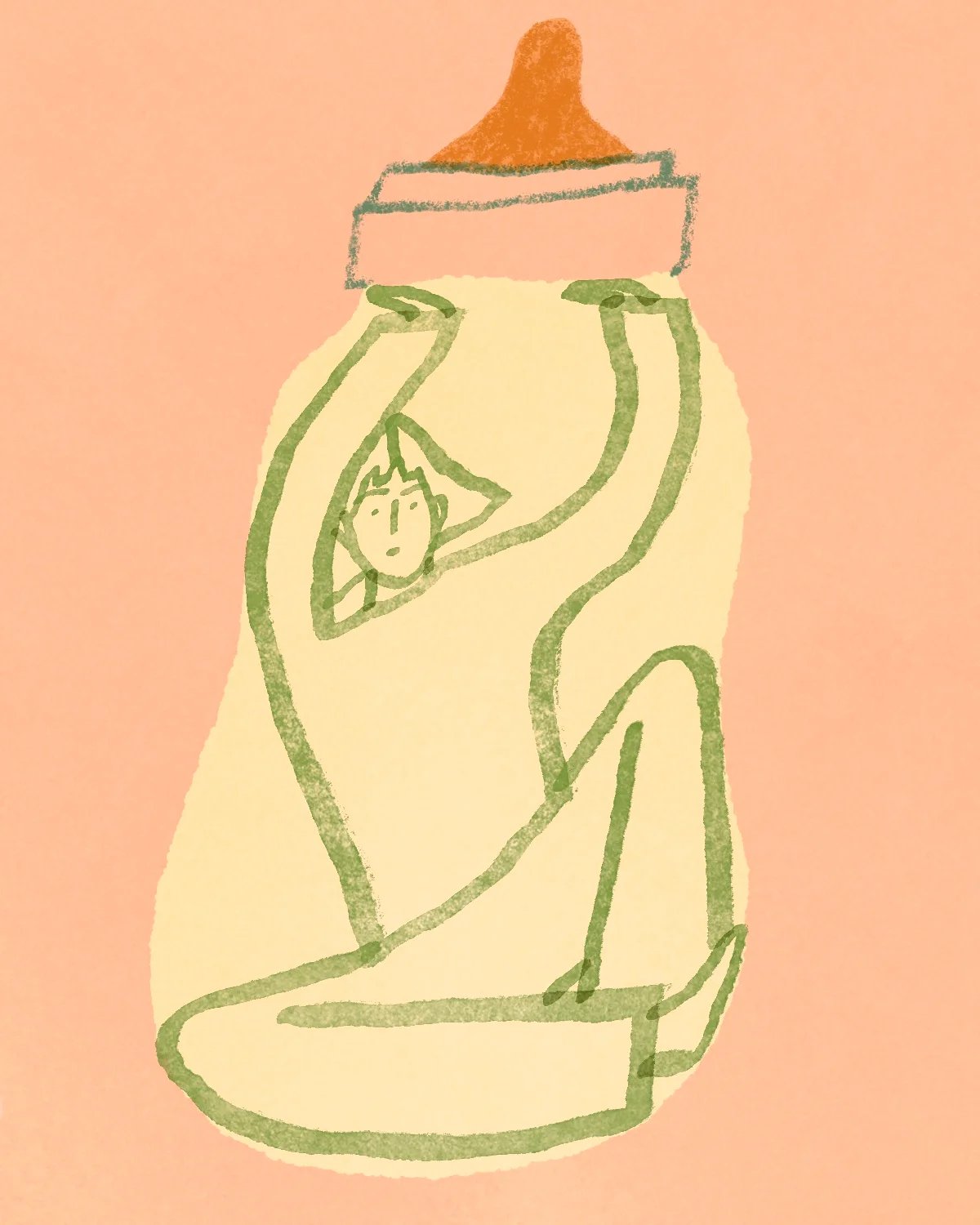
Being food is a lot of pressure. During my career as a restaurant reviewer, cooking columnist, and food writer, I hadn’t considered the perspective from the other side—actually being on the plate. What a singular experience it is to be breakfast, lunch, and dinner for another person. As it turns out, there is an immense responsibility that comes with having to simultaneously sate your audience, nourish someone you love, and quite literally embody a meal.
When I was pregnant with my son, Cole, breastfeeding was always the plan. How cool, I thought, that our bodies can produce exactly what babies need, on demand, all for free. “Many times, you are your baby’s first meal,” says lactation consultant Sunayana Weber, founder of Austin-based It’s More Than Milk. “We encourage every pregnant person to take a lactation class to learn how their bodies make food.” I wish I had because, once my son was born, I quickly learned that my milk wasn’t as accessible as the rotating baked goods at a 24/7 diner. There were a few hurdles we had to go through before I could serve him up that first slice of pie.
For one, as a cruel joke, it can take about 72 hours after giving birth for your milk to fully come in. Your baby’s amuse bouche is called colostrum. “During pregnancy, everyone makes colostrum, which typically starts at 16 weeks,” explains Katie Kivlighan, a certified nurse midwife and associate professor at the University of New Mexico, whose primary research focuses on human milk. “When the placenta delivers, there’s a huge drop in progesterone, and the baby latching releases prolactin, which signals your mammary alveolar cells to switch from colostrum to milk. During that transition, the carbs, fats, and fluids increase and you eventually get mature milk.”
But even once my milk had matured, being food was painful. Somehow, I hadn’t considered this. Brand new people don’t always know how to latch on right away, and in my case, Cole latched but it hurt like hell. Stabbing needles hell. But when a human is hungry, they show very little restraint. Turns out, my human had a tongue and lip tie that had to be surgically released, allowing his entire mouth to loosen up and eventually give my poor nipples some relief.
When you’re food, presentation also matters—just like it does in restaurants. Though this certainly isn’t the case for every baby with a tongue tie, by the time my son was healed from his procedure, he had grown accustomed to bottles. When I offered up my boob, he no longer wanted it. Why order the whole dorado and pick through pin bones when you can have it filleted tableside? Now I am exclusively pumping, and although I am serving him the same exact stuff—me—it seems less natural when it comes from whirring machines, glass bottles, and silicone nipples; I am not some nymph in a forest, surrounded by whimsical deer, with milk flowing directly into his mouth.
“Breastfeeding isn’t always rainbows and butterflies, and feeding challenges are a slam dunk for mood disorders,” says nurse and lactation consultant Olena Dobczansky of The Partum Connection in New York City. “The baby’s mouth is supposed to fit on the breast, right? It’s like a lock-and-key situation. Exclusively pumping can be a reminder, every three hours, that something is ‘wrong.’” Apparently, when you’re food, you can feel guilty.
No matter how you’re expressing your milk, being food is work, and many women describe feeling like a dairy farm. “Some automatically think of an udder or a cow because, depending on where you live, we don’t see women breastfeeding very often,” Dobczansky says. “Even though I had counseled thousands of women before I brought a baby to my boob, the first time was wild! Lots of pulling and tugging, and chemicals flooding to your brain. You are having a fully embodied experience.”
For me, my body feels more like a small, indie coffee shop—all hands on deck with one very frequent and demanding customer. This shop is conscientious of its sourcing, with the knowledge that everything going into me is eventually going into him. I am constantly preparing for, being used as, or recovering from mealtime. I am more aware of my body than I’ve ever been. When I’m ready to feed, my boobs are heavy and taut, like a tightly netted bag of nectarines. Afterward, they are like soup dumplings, soft and squishy with a sensitive tip. “You may get sick of being touched and, for a while, feel like your breasts are not your own,” Weber says. Apparently, being food can feel vulnerable as you bravely put yourself out there to be consumed.
I am always wondering if I’m making enough, which quickly translates to am I enough? When you’re food, you are insecure. “You are learning a new skill with someone who doesn’t speak any language,” Dobczansky says. “This is a recipe for self-doubt. The millennial mom wants to do it right and do it all because that’s what we’ve been sold.” I’m constantly calculating feed amounts and frequencies, ensuring my baby always has plenty to eat. Like a chef, I am meticulously measuring, testing the temperature, and avoiding contamination. I am often critical of my milk’s consistency—is it full fat or too thin? By the time that bottle hits his mouth, I’m spent. Being the food and making the food is exhausting.
Of course, there are plenty of upsides. “One of the beautiful aspects involved in milk let-down is the feel-good hormone oxytocin,” Kivlighan says. “That gets released every time there is stimulation of the nipples, both with baby latching and pumping.” Whether you’re making eye contact with your baby or seeing their little hand tug on your nursing bra, there is an undeniable bond that happens during a feed. “The number one thing that clients remember about breastfeeding is not how many minutes or how many ounces, but how they felt,” Dobczansky says. “That feeling of purpose and closeness is what gets logged into the amygdala and hippocampus, and it’s what stays with us.”
What’s more, I am proud to be food. I recently took a peek at my freezer and, between pouches of broccoli florets and pints of Talenti, are dozens of bags of frozen breastmilk. Long after the last pull of suction, my son will have a supply to keep him going. I did what a lot of people do with food that they’re excited about and snapped a photo that will likely end up on Instagram. As someone who has long covered food systems, putting in the emotional work and sweat equity just to feed one tiny soul underlines the importance of the industry—and what a crucial job it is to provide for the masses.
And, it cannot be overstated, breastmilk itself is magical. “The coolest thing about human milk is that it changes based on babies’ needs,” Weber says. “Every time you put your baby to your breast or chest, or even kiss your baby or do skin-to-skin, that will signal the nutritional value in the milk to adjust.”
My breastmilk volume has increased as Cole has aged, modified its nutrients throughout our days, and adjusted when he’s sick. That last part blew my mind. It would be like going to a restaurant with a slight cold and the kitchen automatically sending out some spicy pho. When Cole was just two months old, our entire household had a stomach bug, and my milk automatically thinned out to provide him with more hydration. As Dobczansky says: “Breastmilk is not just food, it’s immunity.”
That just might be the best part of all. When you’re food, you may be guilty, doubtful, vulnerable, and exhausted, but you are appreciated. You are exactly what your diner needs at that moment. There is nothing like you. You make somebody full.
