


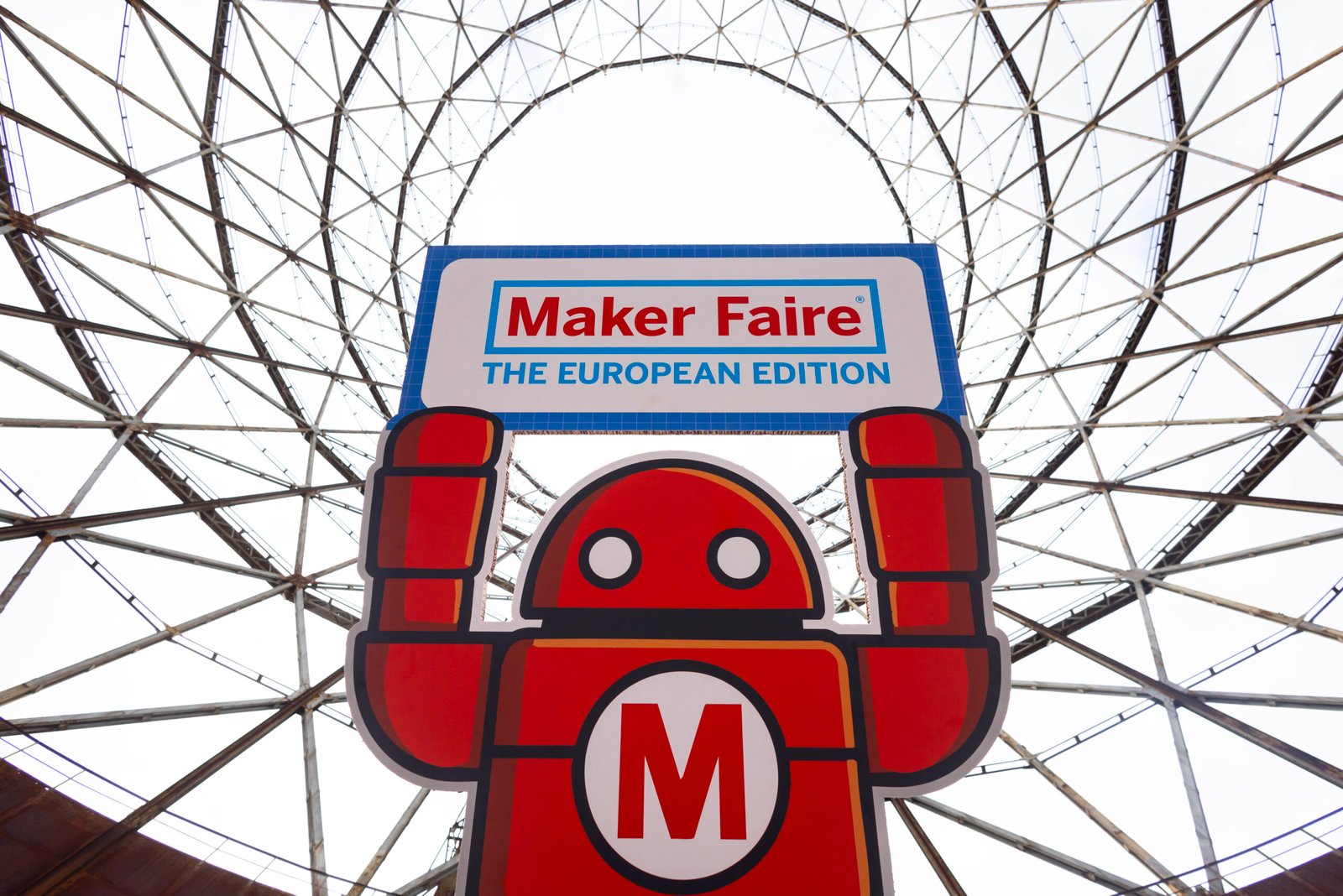

Every October, the Gazometro Ostiense—a former industrial gas plant in the south of Rome—fills with machines that did not exist the year before as well as the rust, steel, and industrial memory of machines past. For three days, October 23–25, 2026, the 14th edition of Maker Faire Rome – The European Edition becomes a place where building is the explanation. Secondary school students present next to university spin-offs. Independent makers next to research labs. Nobody’s pitching, everyone’s showing.
Why it matters? Showing a working prototype or running an interactive workshop in the MakeLab area to thousands of people who are actually there to engage with it — not to scroll past it, not to sit politely through a deck — is a specific kind of useful. The feedback is immediate. The audience is real. And sometimes the room changes what you build next. The projects that show up with a real answer to that — sensors for sustainable agriculture, prosthetics for athletes, communication tools for people the digital transition left behind, AI turbines for places conventional wind power cannot reach, underwater networks monitoring infrastructure the energy transition depends on — are the ones that find their audience here.
Maker Faire Rome is organized by the Rome Chamber of Commerce through Innova Camera, under license from Make:. That means a public institution is running a maker event — which sounds like it should not work as well as it does. It works because the question the event keeps asking is genuinely useful: what does this technology do for people?
How Do I Get There: Call for Makers
The Call for Makers is open worldwide and applications are open now across three free calls: Deadline June 15th, 2026.. Robotics, AI, IoT, digital fabrication, sustainability, wearables, agritech, food technology, space technologies—if it works and you can demonstrate it live to a broad public, it qualifies.
The Call for Schools is open to student teams aged 14 to 18 from Italy and the European Union. Selected schools exhibit free of charge. Travel and accommodation support may be available for eligible publicly funded schools from outside Rome — details in the official rules. Deadline: June 15, 2026.
TheCall for Universities and Research Institutes is open worldwide — researchers, doctoral candidates, university teams, public research institutes, academic spin-offs, STEM and applied interdisciplinary fields alike. Three days in the same place as companies, investors, policymakers, journalists, educators, and thousands of visitors.
If your project is selected, the exhibition space is free. What comes with it depends on the call, but the rules include basic setup, electricity, and Wi-Fi where applicable. Every project is reviewed by an independent Scientific Committee. Since 2013, Maker Faire Rome has recorded more than 895,000 cumulative attendances, with over 8,000 projects from more than 40 countries. WSense and GEVI are two of them. There have been thousands of others.
W-Sense: Underwater Integrated Cableless Solutions

Chiara Petrioli had been thinking about the same problem for years. More than 70% of the planet is underwater, and almost none of it is connected. Not because nobody tried — radio waves simply do not travel through seawater the way they travel through air. So the default was cables, or divers, or sensors that stored data locally and hoped someone would come back to collect it. She built something different. Acoustic and optical signals, moving through water the way radio moves through air. Underwater Wi-Fi, as a useful shorthand. When she brought it to Maker Faire Rome in 2019, WSense was still early — a working system looking for the problems it could actually solve. The room helped clarify that. Ocean infrastructure, marine ecosystems, submerged archaeological sites, the pipelines and cables the energy transition depends on: the use cases were not hypothetical. They were sitting in the audience. The company now operates across Italy, Norway, and the UK. It has raised more than €25 million, won the European Commission’s BlueInvest Award, and taken on a World Economic Forum ocean-data challenge. Fincantieri and the Italian Navy are among its partners. It started as a professor with a signal problem.
Gevi: The first self-training vertical wind turbine

Vertical-axis wind turbines are one of those technologies that have always looked like they should work better than they do. Compact, quiet, omnidirectional — they spin regardless of which way the wind is blowing, which makes them plausible in cities, on rooftops, in places a conventional turbine could never go. The problem is efficiency. Fixed blades mean the turbine responds to the wind it gets, not the wind it needs. A strong gust becomes structural stress instead of power. Three engineers decided the blade pitch should not be fixed. They built a controller that adjusts it every hundredth of a second, reading the wind in real time and responding before the gust has finished arriving. The turbine starts generating at 2.5 meters per second. It fits on a rooftop. According to the company, it produces up to 60% more energy than comparable vertical turbines. They showed it at Maker Faire Rome in 2023. In October 2025, GEVI closed a €2.7 million seed round to move toward production.
To get you excited, here’s a peek at last year’s Maker Faire Rome…

Maker Faire Rome – The European Edition October 23–25, 2026 · Gazometro Ostiense, Rome
Organized by the Rome Chamber of Commerce through Innova Camera, under license from Make:.
Press inquiries: press@makerfairerome.eu
