


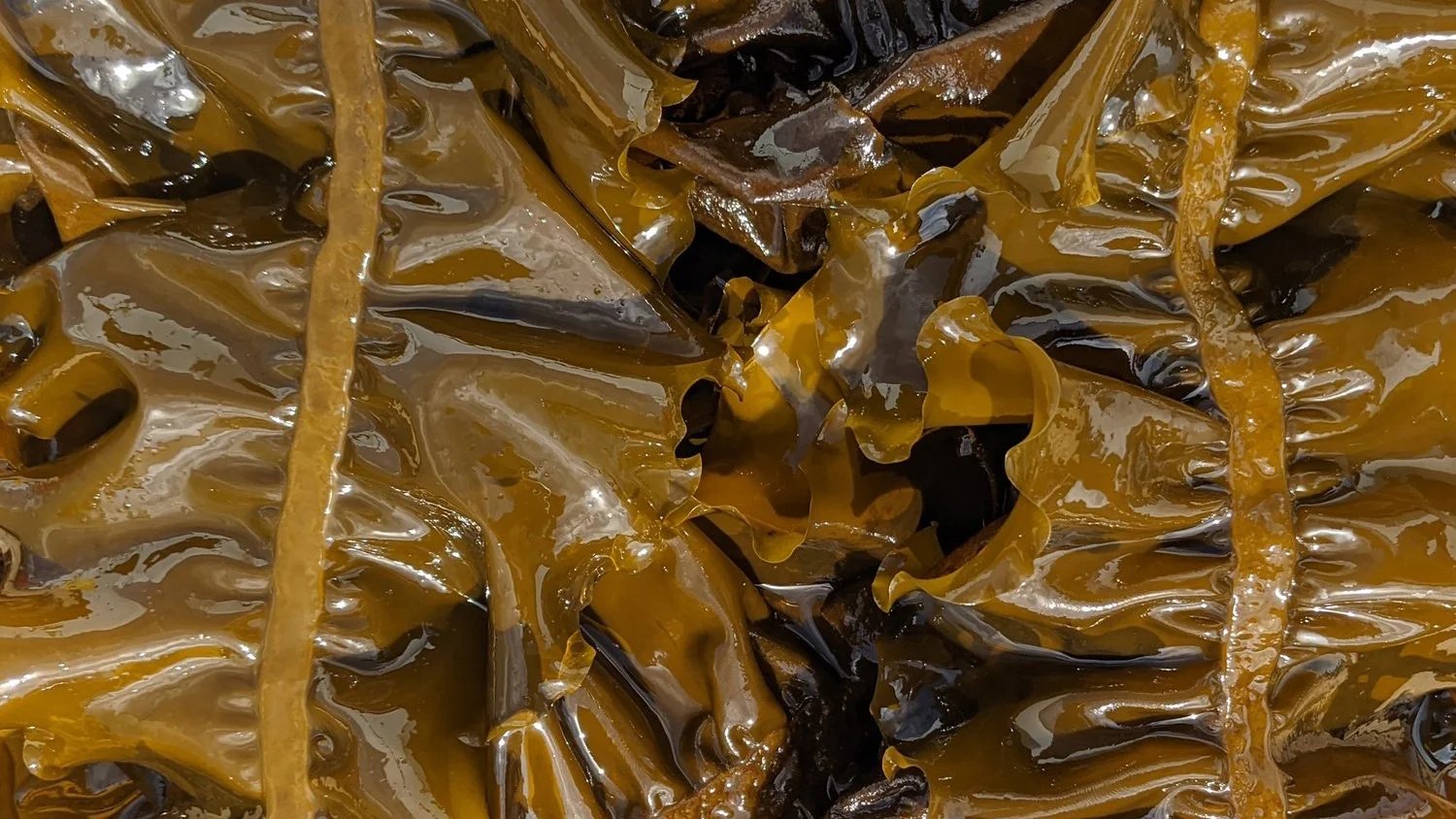
Seaweed tumbles around in a massive tank of cold, bubbling water as Dr. Michael Graham reaches over the edge, grabs a ribbon, and pops a piece of dulse—a reddish-purple variety—into his mouth. The phycologist (a scientist who studies algae) then moves to a neighboring bin and surfaces a handful of sea grapes. He hands me the tiny green orbs, which look like miniature versions of the fruit. The spheres burst gently in my mouth, releasing a pleasant cascade of briny water.

Other than apple orchards and the fruit trees in my parents’ backyard, the Monterey Bay Seaweeds farm might be the closest I’ve come to eating something at its source. Graham’s lean operation—rows of open-air basins clustered a stone’s throw from the shore in Moss Landing, California—requires little input beyond sunlight and ocean water. The macroalgae grown here end up in savory dishes, baked goods, and even cocktails served at restaurants nationwide, but Graham insists that there are other reasons to cultivate edible seaweed. As it grows, seaweed can absorb excess carbon dioxide and nitrogen that’s accumulated in the ocean from fossil-fuel emissions and runoff. This, combined with the fact that it requires no fresh water or synthetic fertilizer, means it can be an ecologically efficient crop to cultivate.


Monterey Bay Seaweeds is one of few farms in the States selling fresh, culinary-grade seaweed directly to consumers. While the global commercial market is projected to swell over the coming years, domestic cultivation remains small compared to that of Asia, which overwhelmingly dominates the world’s seaweed aquaculture. But as the American food industry is increasingly rocked by climate change, more people in the U.S. are turning their attention to the environmental benefits—not to mention the nutrients and economic potential—of macroalgae as a food source. Because seaweed absorbs carbon dioxide through photosynthesis, well-managed farms can strengthen marine ecosystems by helping to mitigate local ocean acidification, which is harmful to coral, mollusks, crustaceans, and more. As cultivators pioneer new farming ventures off both U.S. coasts, the emerging industry is taking steps to not only scale production, but also generate demand in a population that’s largely unfamiliar with eating algae.
Becoming a seaweed farmer isn’t as simple as foraging for algae and watching it multiply. In places like California and Washington, you need a permit to set up in state waters, and acquiring one can be an expensive and highly complex process. Beginners might also struggle with sourcing high-quality seeds, navigating the unpredictable whims of the ocean, and determining best practices for a low-impact, ecologically beneficial operation.


Bren Smith worked in a commercial fishing operation before he became disenchanted by the industry’s destructive environmental impacts. After pivoting to seaweed, Smith created a training program to share his learnings. When 8,000 people signed up, he quickly realized how much the nascent industry needed guidance. The unexpected level of interest led him to grow his grassroots initiative into GreenWave, a nonprofit that offers training and resources to ocean farmers around North America. The organization works to scale regenerative farming through polyculture models that symbiotically pair seaweed and shellfish cultivation.
At its best, seaweed aquaculture can catalyze environmental feedback loops that support surrounding marine life. “With ocean acidification, poor shellfish can’t produce as much calcium carbonate, and their shells become thinner and weaker,” says Charles Yarish, GreenWave’s chief scientist and a researcher at the Woods Hole Oceanographic Institution. Implementing a strategic polyculture system that grows macroalgae alongside shellfish allows farms to improve the balance of the ecosystem. As seaweed photosynthesizes, it can raise the pH of the surrounding waters, helping create more favorable conditions for local shellfish to produce thicker, stronger shells. In turn, the shellfish feed on the phytoplankton that compete with seaweed for nutrients, explains Markos Scheer, founder and CEO of Juneau-based ocean farm Seagrove Alaska.
Polyculture setups can help ensure the seaweed sector grows sustainably, not just ecologically but also economically. “Concurrent to the story of an emerging seaweed industry is the story of fisheries in decline, and threatened livelihoods,” says Kelly McGlinchey, founder of food sustainability consultancy Table & Tilth and former research associate for the Regenerative Agriculture Initiative at the Yale Center for Business and the Environment. Many coastal areas have seen climate change jeopardize the marine species their communities have come to depend on.
In the Gulf of Maine, for example, rising ocean temperatures are driving lobsters farther away from the coast, and populations are on the decline. Seaweed farming could open up an additional income source that makes use of fishers’ existing gear and expertise. “I want to die on my boat one day, and everyone I know and hang out with wants to die on their boats one day,” says Smith. “How do we take all of our skills, our culture, our entire identities, move them over into this climate-solution space, and tap into that blue-collar innovation?”


To that end, lowering the barrier to entry is a logical first step. In Maine, food manufacturer Atlantic Sea Farms supplies lobstermen with seeds and technical assistance as they incorporate seaweed into their existing setups. Founder and former CEO Briana Warner notes that for most lifelong lobstermen, cultivating seaweed isn’t a huge leap from how they’re already working on the water. “I [didn’t] have to teach anyone how to tie a knot,” she says. Moreover, harvesting sugar kelp, the primary seaweed species cultivated in Maine, usually happens in April or May, which generally doesn’t interfere with lobstermen’s busy season: summer to late fall. Once the farmers collect their yield, Atlantic Sea Farms turns it into value-added products like kelp powder, smoothie starters, and gochujang-seasoned salad. “Seaweed isn’t going to replace lobster,” Warner says, but she notes that the crop is still a meaningful step toward building the community’s economic resilience in the face of climate uncertainties.


Much of the appeal of Atlantic Sea Farms’ business model is that someone else takes care of the processing. “Kelp is vulnerable to decay once harvested,” McGlinchey says, which means that having the infrastructure for drying, blanching, or freezing is critical for opening farmers up to higher-volume distribution channels. “You don’t want to be in the business of selling raw kelp,” Smith adds. “It has no shelf life, and you’re going to flood the market with a quarter-million pounds off your farm in a two-week period.” Industry advocates like Smith and McGlinchey emphasize that innovative processing solutions—revitalizing old waterfront facilities or developing cutting-edge methods to stabilize kelp at room temperature—could be game-changers.
Yet even if farmers scale production, the future of the seaweed industry will depend just as much on what happens in grocery stores and at the table. “We haven’t been able to build that market demand as quickly as the capacity for production has increased,” Scheer says. He estimates that Alaska’s farms are only producing about 20 percent of what they could be with a viable culinary market.
The reality is that, despite seaweed’s rapid growth cycles and potential for climate-positive impacts, the ingredient has yet to take hold in mainstream U.S. dining culture. “It’s been an uphill journey for sure, and it continues to be,” Scheer admits. To shift the tides, growers and producers are taking it upon themselves to whet people’s appetite for algae—a tall order, given that they’re trying to fundamentally change America’s perception of the sea vegetable.
“We often handle seaweed as if it’s this artisanal thing, but if we’re going to make an impact, we need this to be in every aisle of the grocery store,” Warner says. Many Americans still consider the ingredient, as Graham puts it, “something you pick off the beach,” or a novel garnish in an experimental chef’s tasting menu. In The Menu, a 2022 dark comedy that satirizes ultra-fine dining during a pretentious and ultimately violent dinner, Graham’s seaweed appears in the very first course, dramatically draped over a plate of rocks. (Dominique Crenn, chef-owner of the decorated Atelier Crenn, was a technical consultant on the film and is a longtime Monterey Bay Seaweeds customer.) Graham says it looked uncannily like what some of his customers might serve at their restaurants. Though it was exciting to see his product on the silver screen, he insists that the ingredient can be more than a fancy flourish, and that eaters should use it “like a vegetable.” Graham notes, “You can make a smoothie out of sea lettuce or a salad out of dulse.”


Many cultures—including Japanese, Irish, and Indigenous American communities—have a long history of eating seaweed. When Candice Choi founded her seaweed snack brand Geem, she drew upon her Korean upbringing to develop something American snackers would crave. “I think America in particular is very crunch-obsessed, me included,” Choi says. Harnessing Korean pantry staples, she combined seaweed with crispy rice and sesame seeds and turned them into crunchy chips seasoned with gochugaru and tamari—her way of celebrating the flavors of her heritage while adapting the ocean green to U.S. palates.
To meet average U.S. consumers where they are, food producers are introducing the ingredient in familiar contexts that leverage seaweed’s unique strengths, like its oceanic savoriness and natural thickening power. North Coast Seafoods sells a briny, herbaceous kelp-based burger, which combines New England seaweed with chickpeas and brown rice. Alaska-based Barnacle Foods uses kelp to add savory notes in salsas and hot sauce. And Maine Coast Sea Vegetables combines it with sesame seeds, brown rice syrup, and maple syrup to make crunchy, salty-sweet sesame bars.
“We need all kinds of innovative product development,” says Anoushka Concepcion, chair of the Global Seaweed Coalition’s strategic advisory council. New food creations, she explains, give the industry a chance to learn what customers are drawn to, whether that’s kelp noodles or seaweed-seasoned chocolate bars. After all, the reality is that customers won’t buy food products for environmental benefits alone. “We’re so jaded by all the greenwashing that’s happened in the last 10, 20 years,” Choi observes. For many customers, she says, sustainability is “a nice-to-have” only after the box for tastiness is checked.
As McGlinchey sees it, chefs have a critical role to play when it comes to shifting people’s mindsets. “They are trendsetters,” she says, “and they have an opportunity to experiment with and normalize new foods in a way that could be incredibly powerful.” In Monterey County, local chefs are some of the biggest advocates of Graham’s seaweed, experimenting with it in a wide range of sweet and savory dishes. Chef-owner Klaus Georis at seafood-driven Maligne has used multiple varieties in his take on chawanmushi, Japanese steamed egg custard. At Coastal Kitchen in the Monterey Plaza Hotel & Spa, chefs Michael Rotondo and Lisa Baty have incorporated briny nori and kombu into a sablé Breton, topping the sweet-salty shortbread with panna cotta and a verdant drizzle of kelp oil. At Cella Restaurant & Bar, barkeep Joshua Perry created an oceanic cocktail in which the cucumber-kombu dashi and a sea-grape garnish evoke “the sun in your face, the sea spray hitting you,” he says. By using seaweed in unexpected ways, restaurants can pique curiosity about the macroalgae’s different forms and push the boundaries of its culinary potential. “Once people become familiar with something, they’re much more open-minded to it,” Georis says.
Making seaweed mainstream requires more than just exposing the masses; it also means educating cooks on how to unlock its versatility. “It’s good at soaking up the flavors of whatever it’s cooked with while also imparting an important flavor of its own—namely, umami,” says Susan Jung, cookbook author and food columnist for Vogue Hong Kong. One of her favorite ways to use seaweed is to toast and shred dried sheets and sprinkle them over rice or soups, like one that Jung’s mother used to make with bean curd, eggs, and sesame oil. You can also make dashi—a Japanese stock with a base of kombu, a type of dried kelp—to enrich brothy dishes like ramen and sukiyaki. The spent kombu, when tossed with seasonings like soy sauce and mirin and sprinkled with sesame seeds, also makes a tasty side dish that’s popular in Japan, Jung adds. Seaweed belongs in any dish that could use a touch more savoriness or brine—think a creamy pasta or a simple pesto.


Fortunately for both chefs and diners, seaweed comes in an array of textures and flavors. Some varieties have dense, meaty consistencies, like the North Pacific giant kelp, which is turned into lasagna noodles at the Eternal Abundance Organic Market & Eatery in Vancouver. Graham’s wife and business partner, Erica, who is a chef, says frying dulse makes it taste like bacon. And if you love truffles but not the hefty price tag, sea truffle uncannily evokes the fungus it’s named after. There are also nutritional perks: Depending on the species, seaweed can be a good source of fiber, protein, and nutrients like iodine, potassium, and magnesium.
Scheer acknowledges that looking for a market while ramping up production can feel a bit like building a car while driving it. That tension is reflected in how growers are increasingly banding together—not just to produce more seaweed, but to support a more consistent supply and widen the crop’s reach. In the bays around Long Island, a group of women from the Shinnecock Indian Nation joined forces to found Shinnecock Kelp Farmers, a nonprofit organization working with GreenWave and the Sisters of St. Joseph in Brentwood to establish their own kelp hatchery and farm—building up local production capacity while reasserting their community’s longstanding role in stewarding local marine resources. The Maine Family Sea Farm Cooperative, also supported by GreenWave, unites multiple polyculture farms in Casco Bay, enabling growers to share resources, pool funds for equipment, and step in for one another during periods of worker shortages. Across the country, such efforts and momentum are laying the groundwork for the kind of stable, predictable supply needed for seaweed to sustain and expand its presence in grocery stores, restaurants, and home kitchens.
Seaweed as an ingredient may be ancient, but it’s still in its early days as a cultivated American crop. Concepcion notes that different U.S. regions are suited to growing different species, and it will take time for farmers to ascertain what kinds of products their seaweed is best suited for—and how those foods will be received by eaters. Land-based farms like Monterey Bay Seaweeds enable daily harvesting and offer growers more precise control over their environments—ideal for selling to chefs seeking the freshest options. Ocean farms, on the other hand, generally have lower operating costs and tend to harvest less often and in larger batches—supplying the level of volume needed for packaged food companies. The bottom line? The industry needs all kinds of farms to meet all kinds of market needs. “The bigger the scale, the lower the cost and the more access people will have,” Graham says. “I think that’s when everything’s going to change.”
