



Low nurse staffing can harm patients, but are the costs of fixing the problems worth the benefits or are there cost-effective alternatives?
Abstract
The NHS, in common with many health systems around the world, faces shortages of registered nurses. Common sense and a huge body of evidence suggest this is far from ideal to deliver high-quality patient care. In acute general hospitals, when there are fewer registered nurses, more patient care is missed, quality is reduced and patient outcomes are worse. But fixing the problem is likely to be expensive and it is important to ask whether this is the best way to spend money in a resource-limited system. Are there alternatives to using registered nurses? In this evidence brief, we summarise a recent systematic review that explored whether investing in registered nurses represents value for money and considered whether using support staff with lower qualification levels might provide a more cost-effective solution to nurse shortages.
Citation: Griffiths P, Ejebu O-Z (ed) (2025) Is it cost-effective to deploy more nurses on hospital wards? Nursing Times [online]; 121: 11.
Authors: Peter Griffiths is professor of health services research; Ourega-Zoé Ejebu (editor) is senior research fellow; both at the School of Health Sciences,
University of Southampton.
- This article is open access and can be freely distributed
- Scroll down to read the article or download a print-friendly PDF here (if the PDF fails to fully download please try again using a different browser)
Introduction
In the UK, the NHS has experienced a significant shortage of registered nurses, with high vacancy rates, for several years. Many countries face similar shortages of registered nurses. This motivates calls for further investment in nurse training and searches for alternative ways of staffing hospital wards. These include the creation of new cadres of nursing staff with lower levels of qualifications and increased use of unregistered support staff (Van den Heede et al, 2020; Twigg et al, 2016).
Extensive research (Dall’Ora et al, 2022) shows that low nurse staffing levels are associated with increased risks of patient death. Other adverse events include falls, infections, extended hospital stays, and negative experiences for both patients and staff (Dall’Ora et al, 2022). Such evidence has been used to argue for increased investment in training and improvements in registered nurse staffing levels. However, showing that increased registered nurse staffing levels are linked to improved outcomes is not sufficient to provide a case for increasing them. Other options, including the use of support staff, are potentially less expensive, because of lower wages and training costs, though this might affect the quality of care. In the face of budgetary constraints and workforce shortages, the relative costs and benefits (that is, cost-effectiveness) of different investments need to be considered.
In this evidence brief, we summarise the results of a recently published review of economic studies (Griffiths et al, 2023), which aimed to identify costs and consequences associated with different nurse staffing configurations in acute hospitals.
Searching for research
The review included economic studies exploring the effect of variation in nurse staffing, including changes in the number of staff and changes in the mix of staff in the nursing team (skill mix) caring for inpatients in acute hospitals. We searched several healthcare databases, such as PubMed, CINAHL and Embase. We made judgements about how reliable the results of the studies were (called ‘risk of bias’) using a framework based on the National Institute for Health and Care Excellence (NICE) guidance for public health reviews and Henrikson’s framework for economic evaluations.
Support staff are cheaper but increasing skill mix is more cost-effective
In total, we found 22 relevant studies with data from 5,900 hospitals and >41 million patients. Most studies were conducted in the US, but we also found evidence from Australia, Belgium, China, South Korea and the UK. Studies were undertaken with various patient groups, but most were undertaken with general medical and surgical patients in general wards.
These studies were all observational, in that they relied on observing the effect of change in staffing or differences between hospitals, as opposed to randomised experiments in which investigators actively changed the skill mix or staffing levels. A small number of studies looked at the impact of planned changes to staffing through policy implementation. Fifteen studies were judged to be at high risk of bias and none had low risk. Nevertheless, the studies reviewed did include some relatively strong designs in which the effect of daily staffing variation on individual patients was observed.
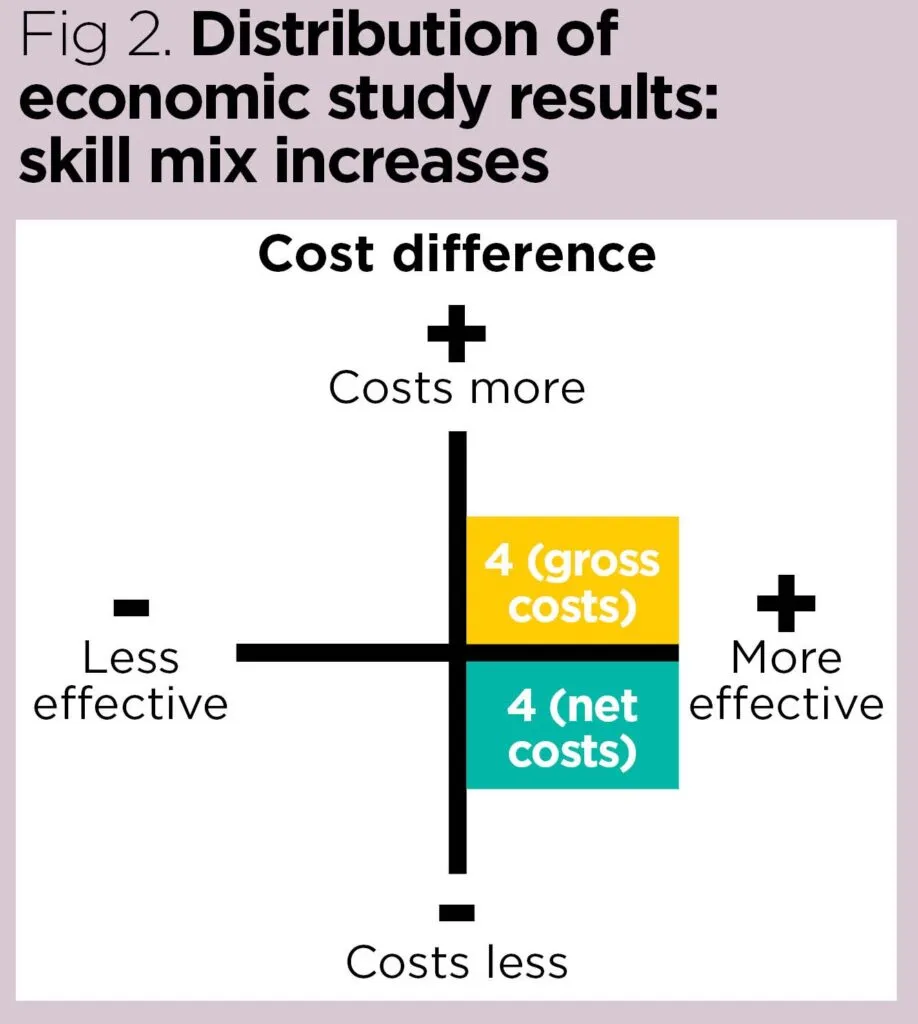
We grouped results according to whether they related to changes in nurse staffing levels (primarily registered nurse staffing) or changes in skill mix (generally the proportion of registered nurses in the ward nursing team). Some studies looked at changes in staff costs only (gross costs), while others also considered other costs associated with the hospital stay or, in some cases, beyond that (net costs). The patterns of results are summarised in Figs 1 and 2.
Six studies found that increased registered nurse staffing led to improved patient outcomes and reduced or unchanged net costs, and so clearly favoured increased staffing as a policy. Most results indicated that higher staffing improved outcomes, but at a cost. For example, in a UK study conducted in a large hospital, when registered nurses provided one extra hour of care per day of a patient’s stay, it was associated with >200 fewer deaths per year at a cost of £150 per admission (Griffiths et al, 2018). In such cases, a judgement must be taken to determine whether a change in staffing level is to be regarded as cost-effective.
We considered a range of recognised criteria for deciding whether increased staffing might be cost-effective. Studies undertaken outside the US, including some done in England, showed that increased nurse staffing was likely to be cost-effective at most thresholds, including one of £10,000 per quality-adjusted life year – a level identified by NICE (2018) as representing exceptional value for money (for new drugs).
In contrast, studies that looked at changes in skill mix provided no evidence that this was cost-effective or delivered improvement in patient outcomes (Fig 2). Even though support staff are generally cheaper to employ, all four studies that considered net costs found that a higher skill mix was, overall, less costly or cost the same while delivering improved outcomes. This was because of reduced costs to treat complications or shorter hospital stays when the skill mix was higher. Studies that considered only staff costs found that a higher skill mix improved outcomes at higher costs, but increased skill mix still seemed cost-effective.
Conclusion
As the evidence is observational, there remains uncertainty around the cost-effectiveness of registered nurse staffing increases, although existing evidence is generally favourable. The evidence of this review lends no support to policies that maintain or increase the size of the nursing workforce through skill mix dilution. In absolute terms, the evidence is limited, but the conclusions are clear: increasing the proportion of registered nurses is associated with improved outcomes and reduced net costs; conversely, reducing skill mix increases costs and makes outcomes worse.
Key points
- The NHS faces marked registered nurse shortages, impacting patient care quality and outcomes
- Evidence supports future investment in registered nurses as a cost-effective way to staff wards
- Evidence does not support reducing registered nurse numbers in favour of lesser-trained support staff
- Strategies addressing nurse shortages that lead to diluting the skill mix are likely to lead to worse patient outcomes and higher overall costs
- This article is reproduced from: Griffiths P, Ejebu O-Z (ed) (2024) Is it cost-effective to deploy more nurses on hospital wards? Evidence Brief; 25. Available at: eprints.soton.ac. uk/487883 (accessed 23 September 2025). Reproduced under the terms of a Creative Commons attribution CC-BY (4.0) licence. This research was funded by the National Institute for Health and Care Research (NIHR), Health and Social Care Delivery Research and Applied Research Collaboration Wessex. The views expressed are those of the authors and not necessarily those of the NIHR, Department of Health and Social Care, arm’s-length bodies or other government departments.
